


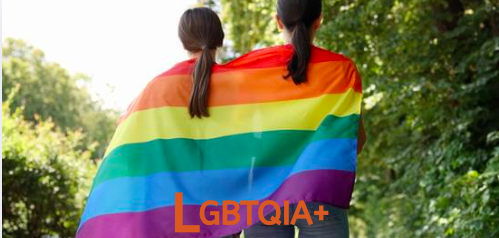
For this Women’s History Month (I’m barely getting it in under the wire!), I want to give a shout out to the “L” in LGBTQIA+: Lesbians. Prior to the 80s, the queer alphabet started with a “G” for gay with lesbians coming in second. The AIDS crisis changed that.
By the way, I used to think that the “+” in the LGBTQIA+ stood for HIV-positive. Makes sense, right? But I now understand that the plus sign is meant to welcome people with any sexual orientation or gender identity not spelled out in the initialism.
When we think of the early days of AIDS, people generally picture hospital wards filled with suffering skeletal men covered in Kaposi Sarcoma lesions. We remember the fire and fury of ACT UP protesting the silence of our government. We remember the funerals after witnessing the agonizing deaths of our friends.
While those powerful images populated every newspaper front page, there was a quieter revolution happening, people stepping up to care for those afflicted by HIV. And many of those who stepped up were lesbians.
One of the most stunning examples came from the San Diego Blood Sisters, a lesbian collective formed in 1983.
At the time, the U.S. blood donation system barred men who had sex with men from donating. The policy aimed to reduce HIV transmission risk in blood supplies, but it also created a problem: people with AIDS often required transfusions, and many potential donors in their communities were disqualified.
By the way, this policy barring men who have sex with men from donating blood remained until 2023! That year, the FDA finally issued revised donor deferral recommendations to include gender-inclusive, sexual behavior-based screening questions for all blood donors. The questions are still borderline offensive, and the answers to these questions are moot, since 100% of all donated blood is tested for HIV and other STIs, Hepatitis B and C, West Nile virus, and HTLV-I/II. Still, we have to celebrate the little wins.
Back to the Blood Sisters. They organized donation drives where lesbians donated blood specifically for AIDS patients. According to archival material from the Yale University Library exhibition on queer history, the group ran twelve blood drives between 1983 and 1990 and recruited hundreds of donors.
Lesbians were also crucial to the AIDS movement itself.
Within ACT UP, lesbian organizers were critical participants in research committees, media strategy, and direct-action planning. Their presence shaped some of the movement’s most consequential policy fights.
One example involved the official medical definition of AIDS. Before it was called AIDS, the condition was called GRID–Gay-Related Immune Deficiency. Early ailment definitions used by the Centers for Disease Control and Prevention (CDC) focused largely on opportunistic infections more common among men. Because of this, many HIV-positive women could not receive an AIDS diagnosis even when severely ill.
Activists, including lesbian organizers working with women living with HIV, pushed for years to change this.
And then there were the countless lesbian women who served as doctors, nurses, social workers, therapists, ministers, advocates and more. These women held the hands of the sick and dying, nursed them, gave them dignity and care when so many were too afraid or too apathetic to do so.
The AIDS crisis created a deep sense of solidarity across queer communities. Since gay male communities were facing mass illness and death, many lesbians considered it a personal and political responsibility to be there when the government, and often families of people living with HIV, wouldn’t show up.
Lesbians showed their heart and strength in the face of AIDS, and that’s why our queer community collectively and lovingly promoted the “L” to the front of the LGBTQIA+ alphabet.
(I don’t want to leave out the work of straight women in the HIV/AIDS movement; they also proved vital in the fight and deserve their flowers, as the kids say. To find out more about how straight women stepped up, I recommend two fantastic books by Author and Activist Victoria Noe: Fag Hags, Divas, and Moms: The Legacy of Straight Women in the AIDS Community, and Unstoppable: Straight Women on the AIDS Frontlines.)




Comments
Comments