

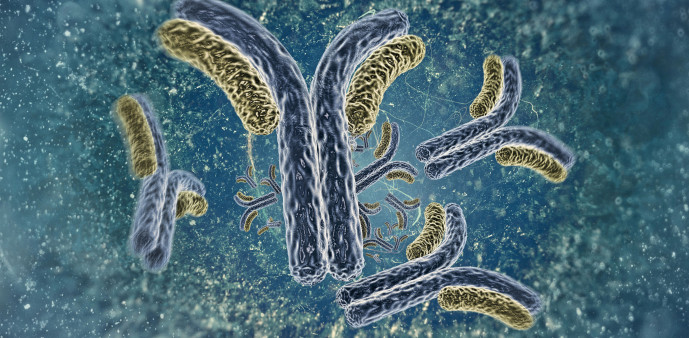
A combination of three broadly neutralizing antibodies (bnAbs) may maintain viral suppression for several months after stopping antiretroviral treatment, according to a small study published in Nature Medicine. This approach is risky, however, for people with antibody-resistance virus.
“Our data suggest that the triple bnAb cocktail can lead to virologic control for a prolonged period of time in most people living with HIV following antiretroviral therapy discontinuation,” senior study author Dan Barouch, MD, PhD, of the Center for Virology and Vaccine Research at Beth Israel Deaconess Medical Center in Boston, said in a news release. He added that larger studies are planned based on these results.
Antiretroviral therapy (ART) can keep HIV replication suppressed indefinitely, but the virus inserts its genetic blueprints into the DNA of human cells and establishes a long-lasting viral reservoir that the drugs can’t reach. This integrated HIV DNA lies dormant during treatment, but it can start churning out new virus when antiretrovirals are stopped, making a cure nearly impossible.
People with HIV normally produce antibodies against the virus, but these usually target parts that are highly variable, so they do not recognize new viral mutations. However, a small proportion of individuals naturally produce broadly neutralizing antibodies that target conserved parts of the virus that don’t change much. Research has shown that bnAb therapy may play a role in HIV prevention, treatment (especially for children) and functional cure. What’s more, novel vaccine approaches aim to train the immune system to produce its own bnAbs. The utility of bnAbs has been limited by viral resistance, but most studies have tested just one or two antibodies.
In an effort to overcome resistance and neutralize more strains of HIV found worldwide, Barouch’s team tested a combination of three complementary bnAbs—dubbed PGT121, PGDM1400 and VRC07-523LS—administered together as an intravenous infusion. PGT121 and PGDM1400 bind to glycans on the HIV envelope, while VRC07-523LS targets the CD4 binding site.
In the first part of the study (NCT03721510), six HIV-negative adults received a single IV dose of the three antibodies. The bnAb cocktail was generally safe and well tolerated, the researchers reported.
In the second part, 12 people living with HIV received up to six monthly infusions of the three bnAbs, with antiretroviral treatment interruption two days after the first dose. The participants were not screened for bnAb sensitivity at baseline, which some advocates have warned is a risky approach when people are being taken off antiretrovirals.
Two participants experienced early viral rebound before the bnAb dosing period ended. But 10 of the 12 (83%) maintained viral suppression for the duration of the six-month dosing period. Half of them experienced viral rebound during the next six months after bnAb therapy ended and levels started to fall, but the other five (42%) showed viral suppression for around a year (9.5 to 11 months), even after serum bnAb concentrations declined to low or undetectable levels.
“Overall, our study showed that three anti-HIV antibodies with significant breadth of neutralization were actually able to maintain virological suppression in the absence of ART at least during the dosing period in a majority of the participants,” said lead study author Boris Juelg, MD, PhD, of the Ragon Institute of MGH, MIT and Harvard. “In a smaller subset, this control was maintained up to week 44 even when the antibodies had reached very low levels in the blood. Future studies are now needed to determine the exact mechanisms of control and how long it can last.”
In an exploratory analysis, the early viral rebound in two of the participants was associated with baseline resistance to PGT121 and PGDM1400. Conversely, long-term viral control in the five individuals with the longest response correlated with reduced immune activation, T cell exhaustion and pro-inflammatory biomarkers following bnAb therapy. However, the researchers did not see a direct effect on the viral reservoir or T-cell responses.
“Our data suggest that the triple-bnAb cocktail can serve as an effective ART replacement in people living with HIV for a prolonged period of time following ART discontinuation, except in individuals with baseline resistance to both PGT121 and PGDM1400,” the study authors wrote.
“Our data show that broadly neutralizing antibodies may offer a new treatment strategy for HIV,” Barouch said. “Long-acting versions of all three of these antibodies are currently being developed, which will likely facilitate the development of a triple bnAb cocktail that may be administered once every six months for both HIV therapy and prevention.”
Click here for more news about HIV cure research.



Comments
Comments