

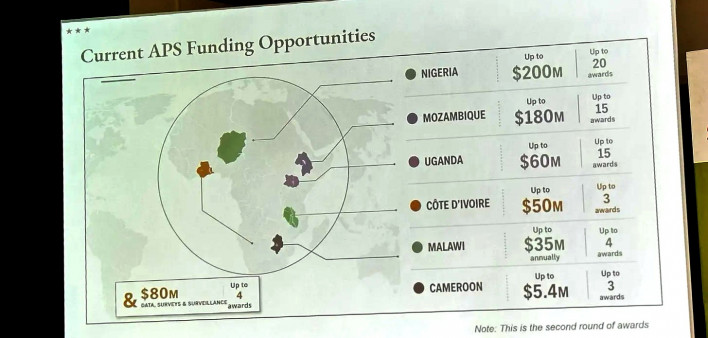
A senior United States government official displayed a mislabeled map of Africa during a State Department presentation at the 26th International AIDS Conference (AIDS 2026) in Rio de Janeiro. The mistake occurred at a preconference event on Sunday, July 26, during a presentation about Washington’s funding for programs that tackle HIV in foreign countries, causing a stir among attendees, many of whom were from Africa.
HIV and AIDS expert Emily Bass was the first to point out the slide’s error in her Substack newsletter:
“The map mis-identified the locations of Cote d’Ivoire, Mozambique, Nigeria by enormous margins—making Nigeria landlocked, Mozambique an east African nation and Cote d’Ivoire a southern African state. The map put Uganda and Malawi in the right vicinity, but with the wrong borders. And it nope’d out altogether for Cameroon, which doesn’t have a line connecting the name to a country at all. (There is also a country without a name. Alas, they are not a match.)”
Further analysis by Reuters of the presentation slides revealed that the image had artificial intelligence watermarks signaling it was created using OpenAI tools.
The presenting official was Jeff Graham, the acting global AIDS coordinator at the U.S. Department of State, who oversees the President’s Emergency Plan for AIDS Relief (PEPFAR). Since 2003, PEPFAR has provided lifesaving medications and services to over 20 million people, mostly in Africa. But under this Trump administration, its funding has been massively undercut, endangering millions of lives.
Regarding the misrepresentation of Africa, a State Department spokesperson said in a statement: “This was an unfortunate error caused by a team member who hastily altered the slide deck immediately before the presentation at the AIDS 2026 Conference. We take full responsibility for the confusion and misrepresentation it caused for attendees, including our African partners.”
Despite the apology, the mishap was widely criticized online.
“Whoever created and approved this slide did not know where countries in Africa are and did not care to check their work,” wrote Matt Petit, who focuses on AI and geopolitics at the Atlantic Council, in a LinkedIn post.
What an embarrassment. This is what happens when @StateDept fires career experts and tries to have AI conduct diplomacy. https://t.co/gOGXJXMycA
— Senate Foreign Relations Committee (@SFRCdems) July 30, 2026
“What an embarrassment. This is what happens when [the State Department] fires career experts and tries to have AI conduct diplomacy,” wrote ranking Senate Foreign Relations Committee member Jeanne Shaheen (D–N.H.) on X.
This chart has been making the rounds in Africa circles for days. While it’s a stupid mistake and embarrassing to see from the US, I think we misdiagnose the issue. To me it’s a reflection of what happens when you fire ⅓ of the State Department, eliminate multiple layers of… https://t.co/qj2zirCL2b
— Cameron Hudson (@_hudsonc) July 30, 2026
Cameron Hudson, a former State Department National Security Council official, called the mistake “stupid and embarrassing” in a post to X.
“To me it’s a reflection of what happens when you fire one third of the State Department, eliminate multiple layers of bureaucracy and have too junior staff performing work under-supervised,” wrote Hudson. “There isn’t just a cost savings when eviscerating staff and expertise. There’s a real cost in reputation and effectiveness.”
Until recently, PEPFAR enjoyed bipartisan support and robust funding. Since it launched in 2003, the global HIV program has saved 26 million lives and enabled 7.8 million babies to be born without HIV, mostly in Africa. Since President Donald Trump took office for his second term in January 2025, federally funded HIV public health programs have seen unprecedented budget cuts domestically and internationally. These include PEPFAR, the Ryan White HIV/AIDS Program, which distributes funding for state and local HIV services and treatment across the United States, as well the Centers for Disease Control and Prevention (CDC) and the United States Agency for International Development.
“A cartographic blunder is embarrassing, but far greater harm comes when that same lack of thought and care influences budget decisions,” wrote Kenneth Ngue, president of the International AIDS Society and a global health professor in Kenya, in an op-ed in The Guardian. “Today, global political resolve to address HIV continues to waver and the funding that has kept millions of people alive has plunged.”
To learn more about budget cuts and program changes impacting international HIV and AIDS public health efforts, check out these POZ articles:
- “International AIDS Conference Confronts a New Reality,”
- “Activists Disrupt Global AIDS Conference to Protest Trump’s Attack on HIV Funding,”
- “How Much Did PEPFAR Cuts Disrupt HIV Care?” and
- “Death, Chaos, Budget Cuts, Exemptions: Updates on Global HIV Program PEPFAR.”
Click here for more reports from AIDS 2026.
POZ is an official media partner of AIDS 2026.



1 Comment
1 Comment