


The Trump administration has rescinded hundreds of National Institutes of Health (NIH) research grants, including many that involve HIV and sexually transmitted infections (STIs). Scientists and advocates have filed a lawsuit to stop the cuts, but prospects for continued funding remain uncertain.
“The National Institutes of Health’s abrupt termination of hundreds of HIV research grants threatens to halt decades of progress,” said HIV Medicine Association chair Colleen Kelley, MD, MPH, in a statement. “The return on investment in HIV research goes well beyond HIV, with the discoveries laying the foundation for curative therapies for hepatitis C and treatments for cancer. Turning our back on HIV research—before we have reached all who need it with HIV treatment or prevention and discovered a cure—will leave us all more vulnerable to HIV and other infectious diseases and have serious consequences for global health security here at home and around the world.”
The NIH is part of the Department of Health and Human Services (DHHS), now under the direction of Robert F. Kennedy Jr. Without a formal announcement of the cuts from NIH or DHHS, journalists and advocates have had to rely on reports from defunded researchers and sporadically updated government listings. The Washington Post estimates that total NIH funding has fallen by more than $3 billion compared with the amount issued during the same period last year.
Even without knowing the full scope of the cuts, it’s clear that HIV and STI research has been heavily affected. Kennedy and new NIH director Jay Bhattacharya, MD, PhD, have said they want to shift the government’s focus from infectious diseases to chronic health conditions.
Many grants were canceled as part of the administration’s push to eliminate “gender ideology” and “DEI” (diversity, equity, and inclusion). Gay and bisexual men, transgender people, Black and Latino people, and people who use drugs bear the brunt of the HIV epidemic in the United States, so much HIV research inevitably focuses on these populations.
In addition, grants awarded to specific universities have been canceled across the board, including funding for Columbia, due to its handling of pro-Palestine protests, and the University of Pennsylvania, because it allowed a transgender woman to compete in women’s sports. Funding for research in South Africa—the country with the highest number of HIV cases—is also under fire.
Several studies of doxyPEP—taking a dose of the antibiotic doxycycline after sex to prevent chlamydia, gonorrhea and syphilis—for different populations have reportedly also been terminated.
“Over 400 NIH grants have been terminated since Trump took office, with an intensification over the past two weeks. Many of these grants involve HIV research, since the stated reason [for cancellation] is diversity, transgender research or even sexual minority research—all topics disproportionally represented in HIV research,” Monica Gandhi, MD, MPH, of the University of California San Francisco (UCSF), told POZ.
“In the history of the NIH, it is rare to terminate grants, and they are only terminated if there is fraud or any other demonstrated abnormality,” she added. “These cuts will have a negative effect on our ability to prevent HIV, to prevent sexually transmitted infections through the highly successful strategy of doxyPEP and to help address important topics in HIV.” Gandhi noted that UCSF has lost six grants so far.
NOAs: What are those? Notice of Awards for grants at the NIH just essentially giving the funds for the next year’s work (not new awards, those are NGAs). The NOA for the ACTG (large clinical trials network for HIV treatment) delayed going out; NIH @DrJBhattacharya please push out
— Monica Gandhi MD, MPH (@MonicaGandhi9) April 4, 2025
According to Gandhi, the notice of award for the AIDS Clinical Trials Group (ACTG)—the largest funder of HIV research worldwide—has been delayed. ACTG chair Joseph Eron, MD, of the University of North Carolina Chapel Hill, told STAT that enrollment for all studies has been paused. Funding for the HIV Prevention Trials Network and the HIV Vaccine Trials Network has also been suspended, STAT reported.
While pharmaceutical companies generally pay for trials of their own drugs, government-funded studies can look at the bigger picture. The ACTG has been supporting HIV research for nearly 40 years. Notable studies include the 076 trial, which showed that AZT (Retrovir) prevents mother-to-child HIV transmission; the SMART trial, which showed that periodic antiretroviral treatment interruption is a risky strategy; the START trial, which found that starting HIV treatment as soon as possible after diagnosis leads to better outcomes; and REPRIEVE, which showed that taking a statin lowers the risk of cardiovascular events for people with HIV. Basic immunology and vaccine research from the HIV Vaccine Trials Network helped lay the foundation for the rapid development of COVID-19 vaccines.
In March, the NIH canceled $18 million in funding for the Adolescent Medicine Trials Network for HIV/AIDS Interventions, which aims to prevent and treat HIV among adolescents and young adults. One of the largest single grants on the chopping block funds a study of HIV prevention and hepatitis C care for people who use drugs, coordinated by Columbia. The Fenway Institute in Boston, which focuses on LGBT health and HIV, reportedly lost five NIH grants in one day.
About 7% of the NIH budget is devoted to HIV, a disproportionate share of funding given that less than 1% of the U.S. population is living with the virus. But, as the COVID vaccine example shows, funding for HIV research has paid off in advances for other diseases.
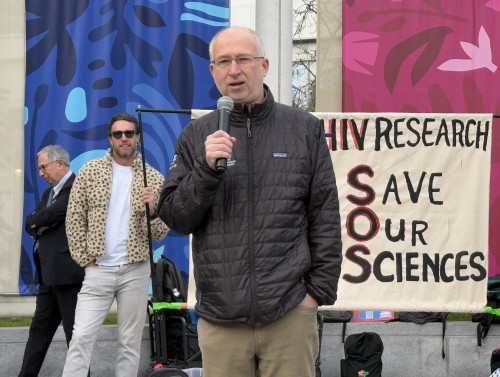
Steven Deeks at CROI Save Our Sciences rally, March 10, 2025Liz Highleyman
“I’ve been involved in HIV research since 1993, and NIH has been very generous to us,” Steven Deeks, MD, of UCSF said at a March 10 Save Our Sciences rally coinciding with this year’s Conference on Retroviruses and Opportunistic Infections in San Francisco. “We collectively have received billions of dollars over the decades, and everybody in the United States who contributed as taxpayers to NIH needs to know that the return on the investment goes well beyond HIV.”
The depth of the cuts has left researchers and advocates both concerned and somewhat surprised, as they seem contrary to the goals of the Ending the HIV Epidemic in the United States. initiative, which Trump himself launched during his first term.
On April 2, the American Civil Liberties Union (ACLU) filed a lawsuit aiming to halt the grant cancellations on behalf of the American Public Health Association, unions representing scientists and individual researchers who lost funding. The plaintiffs argue that the NIH actions are part of an “ideological purge” and a violation of the First Amendment.
“The NIH’s efforts to shut down research that so much as references LGBTQ people or racial minorities is a direct attack on public health,” Olga Akselrod, senior counsel for the ACLU Racial Justice Program, said in a statement. “By censoring studies that include these populations, they are also undermining critical research on cancer, HIV and Alzheimer’s—diseases that affect us all.”


1 Comment
1 Comment