

The morning of Friday, June 6, the Reverend Carmarion D. Anderson-Harvey, a Black transgender activist and minister from Birmingham, Alabama, delivered a sermon from the rainbow-flag-bedecked pulpit of the grand National City Christian Church in Washington, DC, to the assembled crowd of transgender, nonbinary and intersex people and their allies who’d gathered from all over the country.
“Policies have been passed to erase our existence,” she said, her clear, strong voice echoing through the church, “yet here we are, standing firm in our truth.” Anderson-Harvey went on to compare the relationship between the Trump administration and the trans community in the United States to the biblical story of the Pharaoh and the Israelites. Just as the Pharaoh was determined to stop the Israelites as their power grew, President Trump is determined is to do the same to trans and nonbinary people, she said.
“This is what happens when those in power fear the divine image in marginalized people,” she said. “Because we as a community have abundant power. We are made for this. We can manage in places not designed for us. We didn’t travel all the way to Washington, DC, to sit silent while the world legislates our erasure.”
Her fiery words marked the climax of an empowerment session that was part of the Empowerment and Wellness Day sponsored by the United Church of Christ that took place on day 2 of the four day, sixth annual National Trans Visibility March (NTVM). Anderson-Harvey was NVTM’s national director for faith-based and wellness initiatives.
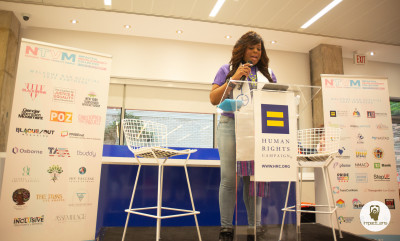
Reverend Carmarion D. Anderson-Harvey at the NTVM pre-rallyPavni Guharoy
According to Dr. Elijah Nicholas, lead strategy director for this year’s NTVM program, which drew roughly 5,500 participants from all over the country at a time when the Trump administration has launched an unprecedented volley of attacks at the trans community. Those attacks have included executive orders declaring that the United States recognizes only the sexes male and female; that people’s passport gender markers must match the sex they were assigned at birth; and that transgender people must leave the military. They’ve also included funding pullbacks and threats to universities, health centers and nonprofits for anything deemed by the administration to promote “gender ideology,” even though most of these entities are merely doing research on behalf of or providing services to transgender or nonbinary people.
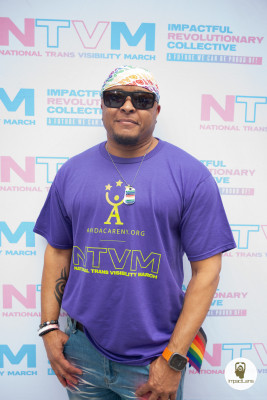
Dr. Elijah Nicholas, the lead strategy director for this year’s NTVM programPavni Guharoy
The sheer speed, volume and vitriol of the anti-trans attacks—far worse than those waged during Trump’s first term—have left the trans community both reeling and doubly resolved to fight back.
“We knew we couldn’t do business as usual this year,” Nicholas, who is also the founder of the Global Trans Equity Project, told POZ. “That’s why we decided to include a policy and safety summit [on Thursday, June 5]. The summit included a legislative policy working session, a program on navigating state-specific primary elections, panels on travel safety for trans people, a press conference in partnership with AP and more.
Nicholas said the policy summit showed him “the importance of community—how we move together in community and solidarity.” The following day, he said, about 25 trans activists and advocates convened at Georgetown Law’s O’Neil Institute for National and Global Health Law to draft a strategy blueprint titled Legacy in Motion that will be published in the future. “It’s going to be the way forward, so we assure that we never get to this place again.”
Nicholas also said that now more than ever, larger LGBTQ or progressive groups that ask the trans community for its participation must be ready to give trans folks genuine representation at the table—and to pay them for it. “The only way we’re going to move forward is through economic stability. It’s time-out for asking trans people to show up for a day and pay them $500 and then not invest in them again until next year. That’s not going to change the landscape.”
Marissa Miller, who founded NTVM and is living openly with HIV, said the Legacy in Motion blueprint would be akin to the foundational Denver Principles drafted by people with AIDS at a conference in 1983 that demanded that people with AIDS be at the center of any policy decisions made about them.
“This is the first convening of our community on a national and global level,” she said. Miller emphasized that the health-related discussions at the policy summit went well beyond HIV (which impacts transgender women at disproportionately high rates) and also addressed the Trump administration’s threats to health care, which affect trans people in particular and vulnerable Americans in general. She noted that Nicholas was a military veteran who himself faced losing the health care he receives from the Veterans Administration. Ultimately the discussion was “about how we have to come together to make change,” she said.
Speakers at the policy summit included trans allies Representative Laura Friedman (D–Calif.), Representative Pramila Jayapal (D–Wash.) and Representative Sara Jacobs (D–Calif.). Friedman spoke out against attacks on LGBTQ (especially gender-affirming) health care, and Jacobs condemned the current administration’s efforts to remove trans people from the military. Jayapal told the crowd: “Thank you [for sending] a very strong message to everyone in this country that trans people will not be erased.... We are not going to give in to the hate.”
Moments of Honor and Recognition
The NVTM program offered many other events, including an evening ceremony at which Paul Kawata, the cisgender executive director of NMAC, a national HIV advocacy organization, received NTVM’s Lifetime Allyship and Justice Award. Kawata has been with NMAC since 1989 and intends to retire next year. In introducing him, a visibly moved Toni Newman, director of NMAC’s Coalition for Justice and Equality Across Movements and board chair for the group Trans Can Work, said that as her supervisor, Kawata “has supported me in everything I’ve ever asked in the name of transgender folks.... He’s a visionary leader, a steadfast ally and a true friend of the trans community. His commitment to inclusion has never wavered, even when the path is difficult, like it is now.... He has ensured that trans voices were not only heard but respected and celebrated.”
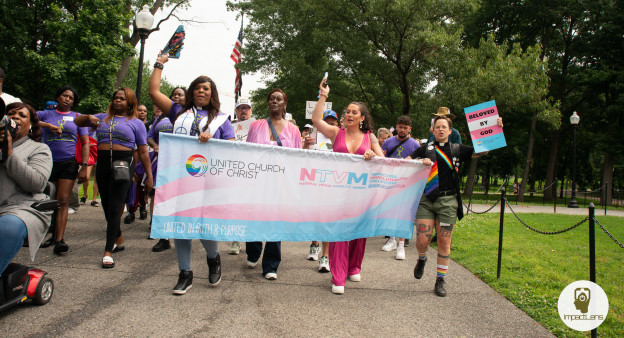
On Saturday, many NTVM participants took part in the larger WorldPride Parade presented by the Capital Pride Alliance before frolicking at an NTVM pool party at the Hyatt Regency Crystal City in the afternoon. Early on Sunday morning, a large number of NTVM participants convened at the headquarters of the Human Rights Campaign, the nation’s largest LGBTQ rights and advocacy group, and marched to the International Rally + March on Washington for Freedom, which was taking place on the National Mall in front of the Lincoln Memorial. Along the way, they chanted: “When I say trans liberation, you say now!”
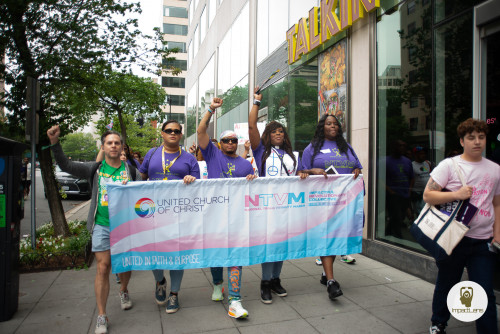
The 2025 National Trans Visibility MarchPavni Guharoy
Tyler Hack, 20, founder of the trans-led Christopher Street Project, which formed early this year as the first political action committee (PAC) specifically for transgender rights spoke at the rally. “I talked about how fighting for trans people means fighting for parents, doctors, immigrants and teachers,” they said about their speech. “We need to fight on all fronts, with some of us doing direct action, some of us doing legal work.” Christopher Street Project focuses, they said, “on the legislative and electoral pieces of the puzzle.”
Hack also said they do the work they do in part to honor their great-uncle, Mark Sheer, whom Hack says was beaten up at the original Stonewall LGBTQ uprising in New York City in 1969. “This is a way to honor our shared history,” they said.
Solidarity and Community in the Face of Attacks
Throughout the weekend, no one could escape the profound cloud of hostile attacks by the current administration hanging over the transgender and nonbinary community. Everyone understood that the current administration has weaponized transphobia in the name of building political power—and that some of the support the community has in recent years enjoyed from the larger world has evaporated under that hostility, especially among Republican leaders terrified of stepping out of line with the president’s whims.
Arianna Lint, a trans Latina living openly with HIV, founder of Arianna’s Center, which provides support to trans people in Ft. Lauderdale, Florida, and Puerto Rico and the Latina strategy director for this year’s NTVM, told POZ that, prior to Trump’s return to office, her Republican congresswoman, Maria Elvira Salazar, would always meet with her or take her calls but now doesn’t reply. “And that’s happening with pharmaceutical companies and foundations too,” she added.
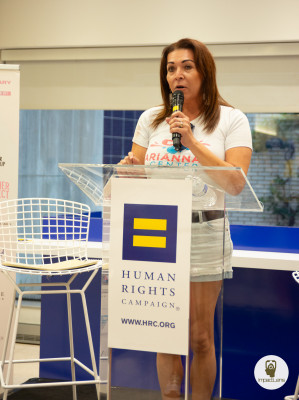
Arianna Lint, founder of Ariana’s Center and the Latina strategy director for this year’s NTVMPavni Guharoy
Similarly, Hack said that none of the few relatively moderate-seeming Republicans that Christopher Street Project had asked to meet with had responded. Thus far, they said, the group has only met with Democrats. “If people are willing to sit down with us and actually understand what trans people are going through, we’re all for it,” they said.
Lint also spoke about the overlap in attacks on the trans community and the current administration’s current and planned cuts to an array of funding streams serving people living with HIV, including Centers for Disease Control and Prevention funding and, crucially, Medicaid, which serves about 40% of Americans with HIV. She noted that about 26% of trans women in the United States are living with HIV. “A lot of us could end up without access to services,” she said.
Precisely because the political climate has turned hostile toward trans people, many NTVM participants said it’s that much more important that trans folks come together as a community at this time—not only to share resources but also to find strength and joy in solidarity at a time when many trans people feel isolated, afraid and dejected in their local communities.
Miller said she’d found healing over the four days merely from meeting with friends, colleagues and comrades she usually sees only on Zoom calls. “To stop and spend some time with folks, to laugh and enjoy ourselves” was heartening, she said. “It was a chance for us not to be alarmed for four days. People were able to let their guard down and be loved on.”

Participants at the NTVM pre-rally at the headquarters of the Human Rights CampaignPavni Guharoy



Comments
Comments