

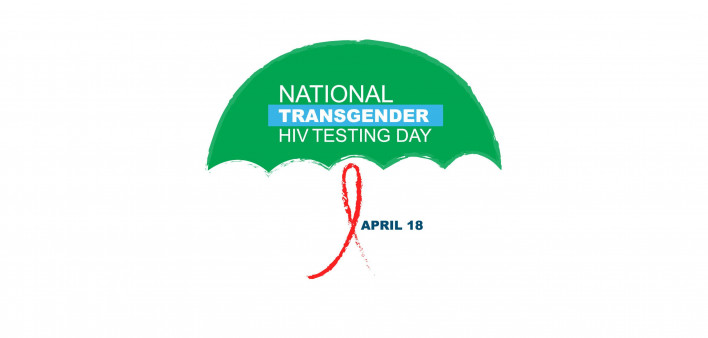
Friday, April 18, marks National Transgender HIV Testing Day 2025 (NTHTD), which promotes the importance of routine HIV testing and status awareness as well as HIV prevention and equitable access to care for transgender individuals.
Transgender, gender-nonconforming and nonbinary people are at greater risk for HIV and are more likely to be living with HIV than the population at large. NTHTD encourages the estimated 1.6 million transgender people in the United States to learn their HIV status and access information about prevention and care options.
Click #NTHTD on social media to find related campaigns and events. Several examples from recent years are included in this post.
View this post on Instagram
NTHTD was established in 2016 by the Centers for Disease Control and Prevention (CDC) and the University of California San Francisco’s Center of Excellence for Transgender Health (CoE).
This year, the CoE developed a transgender HIV testing tool kit to provide information on the most current HIV prevention research, access to care, best practices for serving trans, gender-nonconforming and nonbinary people and more. It also offers guidelines for expanding culturally competent care among HIV testing programs and services.
“A connection with a trusted provider who is also linked into a collaborative network of other providers can open doors to multiple avenues of HIV care and prevention, such as mental health care, case management, legal services, employment services and social support networks,” the CoE tool kit reads.
View this post on Instagram
CoE’s tool kit offers sample social media posts to promote HIV testing, prevention and treatment in the transgender community as well as guidance on how AIDS service organizations and other interested groups can participate in NTHTD activities.
“Providing HIV testing services for trans people on NTHTD on April 18 is not the only way to contribute to the NTHTD,” according to the tool kit. “Funders, providers and community advocates are encouraged to host community engagement events that promote HIV testing and status awareness among trans people.”
View this post on Instagram
In the United States, about 1.2 million people are living with HIV. In 2019, transgender people accounted for 2% of new HIV diagnoses—671 out of 36,801 new HIV cases—according to the latest available data from the CDC.
The CDC estimates that around 14% of people with HIV do not know they have the virus, and nearly 40% of new HIV infections are transmitted by people who don’t know their status. But accurate data about how many trans people are living with HIV have been hard to come by due to inadequate research and changing definitions.
View this post on Instagram
Knowing one’s HIV status is the first step in accessing HIV treatment if positive and pre-exposure prophylaxis (PrEP) for prevention of the virus if negative.
Getting tested for HIV is easy. Indeed, HIV testing is widely available at a number of health facilities—private medical practices, public health clinics, hospital emergency rooms, pharmacies and mobile testing vans.
Despite this, many people avoid getting tested for various reasons, including anxiety and fear of stigma and discrimination.
In 2023, “Let’s Stop HIV Together,” the national campaign of the Ending the HIV Epidemic in the U.S. initiative and the National HIV/AIDS Strategy, launched TakeMeHome, a program that mails free HIV self-test kits anywhere in the country. The program has delivered more than 443,000 kits nationwide.
The TakeMeHome website answers common questions about HIV testing, prevention, results and more. The program aims to deliver one million HIV self-test kits by 2028. Complete a form in as little as three minutes and have a discreetly packaged kit shipped within days.
To read more, click #HIV Testing or #Transgender. There, you’ll find headlines such as “With Data and Determination, HIV Science Conference Urges Commitment to Trans Lives” and “A Physician’s Reflections on Transgender Day of Visibility.”
See POZ’s Health Basics on HIV Testing for an overview on types of HIV tests, risk factors and more. To find HIV testing sites near you, browse the POZ Health Services Directory.


Comments
Comments