

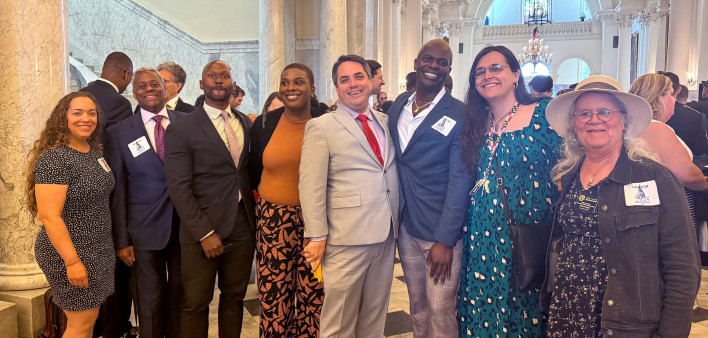
Finally, some good news this week about lawmakers. The governor of Maryland, Wes Moore, signed into law a bill that decriminalizes HIV. Specifically, the bill repeals an old law that made it a crime to “knowingly transfer or attempt to transfer” HIV to another individual. Under outdated laws like this, people with HIV can be sentenced to prison in cases where HIV was not transmitted and their only crime was allegedly not disclosing their status. Such unjust laws not only lead to stigma but also to folks not getting tested to learn their HIV status.
This does not mean that people cannot be held accountable for intentionally transmitting HIV. Other laws on the books, such as those against reckless endangerment, can be used to prosecute such cases.
GOOD NEWS: This week, Maryland Governor Wes Moore signed a bill that decriminalizes those living with HIV. The law also modernizes the state’s approach to HIV and removes barriers to care. Thank you, @govwesmoore.bsky.social, for your leadership and for supporting our community.
— Human Rights Campaign (@hrc.org) May 22, 2025 at 5:12 PM
[image or embed]
HIV criminalization refers to the use of unfair laws to target people who have HIV—notably, African-American, Latino and LGBTQ people and women—and to punish them because of their HIV status, not because of their actions. Many HIV laws were passed in the early days of the epidemic, when fear and lack of scientific knowledge about the virus reigned. Fast-forward four decades. Today, we know, for instance, that people with HIV who take their meds and maintain an undetectable viral load do not transmit the virus sexually, a fact referred to as Undetectable Equals Untransmittable, or U=U.
The Maryland bill has been in the works for over a decade. It was recently spearheaded by Kris Fair, a state delegate. “I credit the HIV community for teaching me about this issue, of which I knew nothing about,” Fair told the Frederick News-Post. “They spent a lot of time helping me understand the unique challenges that they experience day in and day out, because they never know what simple interaction could lead to a criminal charge.”
The bill, HB39, is named the Carlton R. Smith Act, after a Baltimore HIV activist who died last year. The law goes into effect October 1.
Maryland is now the fifth state to have repealed outdated HIV criminalization laws, according to the Center for HIV Law and Policy (CHLP).
“This victory reflects years of tireless advocacy by people living with HIV, legal experts and public health leaders who know that criminalization undermines public health goals,” said Jada Hicks, senior attorney at CHLP, in a statement from the organization. “It is especially monumental to achieve this victory in a time when the very existence and rights of our communities are under attack. This is what resistance against systemic injustice and discrimination looks like in action.”
The CHLP statement also notes that “in Maryland, Black men are 14% of the state’s population, 44% of those living with HIV and 68% of those accused in HIV-related criminal cases. As a result of this law’s passage, there are 14,837 Black men living with HIV in Maryland who will no longer live under the threat of being criminalized due to their health status as people living with HIV.”
Across the nation, 32 states still criminalize HIV, and 28 states have harsh criminal penalty enhancements based on a person’s knowledge of their HIV status. To learn more about HIV criminalization in the United States, see “Explore updated Maps and Data on HIV Crime Laws” and click #Criminalization.


Comments
Comments