

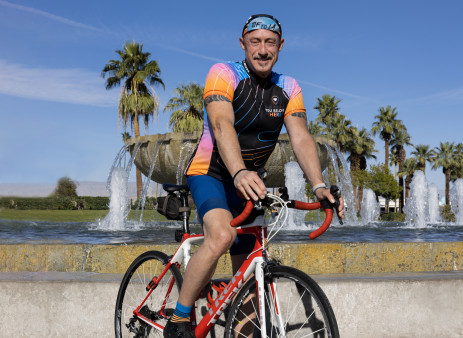
As Brett Klein of Palm Springs, California, gears up for the California AIDS/LifeCycle taking place June 1 to 7 from San Francisco to Los Angeles, he’s eager to shatter a major fundraising milestone.
“When the ride happens, I will have raised over $100,000 during my eight years participating,” he tells POZ. “That includes three years as a roadie and five years as a rider. I’m very proud of that.”
Klein has personal and professional skin in the game. Currently the marketing and events specialist for Eisenhower Health, Klein was the president of the HIV+ Aging Research Project–Palm Springs (HARP-PS) and served on the board of Dining Out For Life International. He tested HIV positive in 1993.
Founded in 1994 as the California AIDS Ride and rebranded in 2002, the event has raised over $300 million for HIV treatment and prevention. By demonstrating their prowess as endurance athletes, the riders, many of whom live with HIV, have challenged the stigma associated with the virus.
“I did my first California AIDS Ride in 1999,” Klein says. “I was a roadie, which can be very long days. Those days were so hard that I decided it’s easier to ride.”
“It’s 545 miles on a bike over seven days,” Klein explains. “The first three days are by far the hardest, up to 110 miles per day, navigating hills and weather from San Francisco to Los Angeles. There’s no easy day per se, but you just grind it out. They have support stops every 20 miles. We’re heavily supported out there.”
For Klein, the annual bike ride is a chance to find fellowship with other riders and to challenge himself physically and mentally. Klein believes that living with HIV has given him an edge, especially on the days when he’s forced to dig deep on the road. “People living with HIV know how to adapt,” he says.
This year’s ride is slated to be the last, marking the end of an era. The deadly wildfires in Southern California were just the latest setback for organizers still working to bounce back from diminished ridership resulting from the COVID-19 pandemic and the changing HIV landscape.
“It’s an interesting time because of the LA fires,” Klein says. “Everything you see on TV, the damage to the Pacific Coast Highway—that’s usually the backdrop for our final day, entering Los Angeles. It’s a big question how this all will transpire.”
Klein is already looking ahead to continue his fundraising. “We are going to participate in some Northern California weekend rides, and Los Angeles folks may do the same,” he says. “And then we’re going to host something here in Palm Springs next year, possibly a two-day social ride, fun yet challenging, just to keep the AIDS Ride spirit alive and mostly to keep the message alive. The whole point of the AIDS Rides is to remind people—-especially in the next four years—that HIV has not gone away. It’s still here, and people are still going undiagnosed.”


Comments
Comments