

Anyone who has grown up never knowing a world before Undetectable Equals Untransmittable (U=U)—the fact that people living with HIV on effective treatment cannot transmit the virus via sex—and the HIV prevention regimen pre-exposure prophylaxis (PrEP) might have a hard time understanding what happened in San Diego in November 1997 at the Creating Change conference, an annual gathering of LGBTQ advocates organized by the National Gay and Lesbian Task Force.
But what indeed happened speaks to both the immense grief over AIDS losses and the fear of HIV transmission that prevailed at the time. On a panel about HIV prevention, a handsome, brainy Mexican-American queer activist living with HIV named Tony Valenzuela, then 29, said before a jury of his peers: “The level of erotic charge and intimacy I feel when a man comes inside me is transformational, especially in a climate which so completely disregards its importance.” And then he went on: “I am a sex gourmet in a community serving sexual TV dinners.”
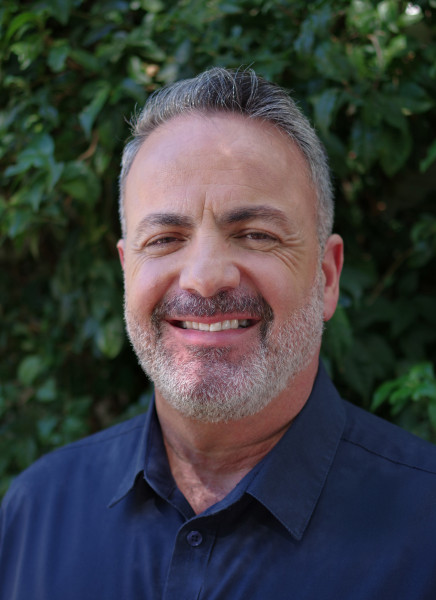
Tony ValenzuelaP James Melikyan
It didn’t matter that he added, “When I talk about having unprotected sex, I am speaking for myself and not as a proponent of condomless sex for all.” It also didn’t matter that he was talking about being a bottom (the one who receives, not gives, during anal sex) and that it was well established by that point that it was difficult for a top to get HIV from a bottom. Nor did it matter that, often, Valenzuela was having sex with other gay men living with HIV—a practice known at the time as serosorting (having sex with people of the same HIV status).
Despite all that, the room erupted in outrage, with one audience member after another denouncing Valenzuela. Said one lesbian activist, according to “They Shoot Barebackers, Don’t They?” a 1999 POZ article about the event: “Lesbians have been, in a way, the wife of the gay male movement. You got sick, and we were there. I’m not saying, ‘We did this for you, and therefore you’ve got to be a good boy.’ But you wonder why we’re so upset. Because 15 years later, when we’re facing breast cancer [and other problems], we’re hearing ‘I want to do what I want.’ Well, do what you want. But I’m not going to be there to clean up after you this time. I have too much pain.” She was loudly applauded.
A torrent of anti-Valenzuela op-eds in LGBTQ papers followed. “Tony is responsible for speaking out to a room full of young students, parents and community members,” read one, written by a member of San Diego PFLAG, “with the words, ‘It is OK to have unprotected sex whether you or your partner is HIV-infected or not because it is the only way you can experience the spiritual aspect of sexuality.’”
To hear Valenzuela, now 56 and living happily in Los Angeles with his longtime husband, Rob, tell it today—that’s not what he meant at all. “What I was trying to say was that sex without condoms is not easily given up or disposable,” he says on a call from his office in Hollywood, where he helms One Institute (formerly the ONE Archives Foundation), which does public educational programming around its massive collection of LGBTQ documents and photos dating back to the 1930s, which are housed and viewable at the University of Southern California.
Valenzuela points to studies in the ’80s and ’90s that found that when asked, up to half of gay men said they either declined or failed to use a condom every single time during sex. “I felt like I was giving voice to that reality,” he says, “but I should’ve realized that many people there were going to be hearing that idea for the first time.”
That may be understating it. “Because after I gave that speech, my life turned upside down,” he says. “There was so much vitriol directed toward me. I was reading about myself in gay newspapers nationwide, and, without fail, I was always written about in some deeply biased way.” He became so bitter that he agreed not only to talk to POZ about it in 1999 but also to appear naked, from the waist up, lying on a real live horse—bareback, of course. He was interviewed by POZ contributing editor Stephen Gendin, who agreed with Valenzuela that practicing sexual harm reduction and being honest about one’s desires were not incompatible. Gendin died in 2000.
The spicy cover line read: “Tony Valenzuela and the Boys Who Bareback Take You on a Ride Inside.” Says Valenzuela now: “Me on that cover was my middle finger to the world.”
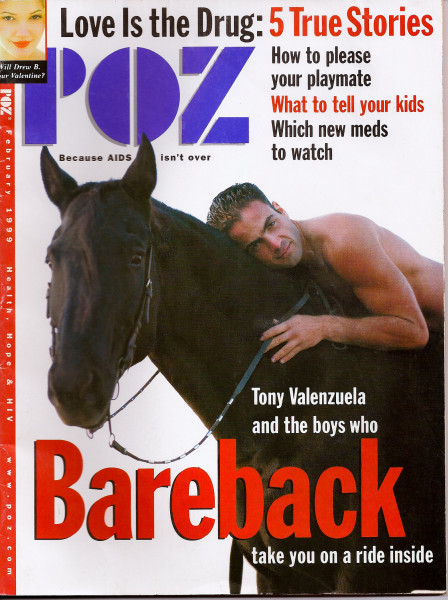
Valenzuela on the February 1999 POZ cover
But beneath the anger lay deep hurt that a community he had given so much to had discarded him so easily. His career as a queer activist started in 1987, in college in Santa Barbara, when his roommate found his journal and told their entire dorm that Valenzuela was gay—and that he frequented the local bathhouse. After a female friend finally told Valenzuela about the gossip, he had his resident adviser call a surprise dorm meeting and came out to the entire dorm. “I stood up and said, ‘I’ve felt different my whole life. I’m gay—and I’m not ashamed of it.’”
He was met, to his surprise, with almost complete acceptance and hugs. (He cries when recounting this part of the story.) When the school asked Valenzuela whether he wanted to see his roommate expelled, he answered that probation would suffice. (“I wasn’t going to be responsible for ruining his life.”)
So it was ironic that he had been accepted by largely straight people in college, only to be rejected by his own LGBTQ peers after the Creating Change conference. He couldn’t get a job in queer activism to save his life after that, he says, so he started doing sex work to make a living as well as a little bit of porn as an openly HIV-positive actor, including a video with an HIV storyline titled Positively Yours. “That allowed me to buy a computer and go to conferences,” he says. “And I also decided that I was going to be open about escorting” to try to counter the stigma against it—a choice that earned him yet more disapproval from some corners of the queer world.
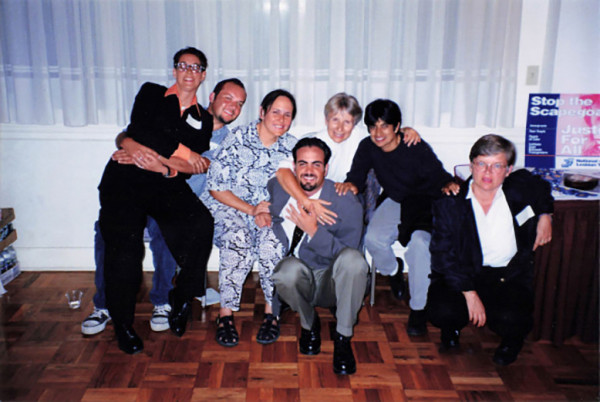
Valenzuela (center) with activists, 1994Courtesy of Tony Valenzuela
Meanwhile, he met Rob in 2004, went to grad school for creative writing and began quietly volunteering at the longtime LGBTQ nonprofit Lambda Literary, diligently working his way up the ladder until he was announced as the group’s new executive director in 2009.
And announced without incident, one should add. “By then, nobody either knew or remembered or cared about the old me,” he says. “I was just some competent arts administrator.”
Valenzuela remained at Lambda Literary until 2018, when he left for a brief stint to head the Foundation for the AIDS Memorial in West Hollywood before becoming head of One Institute. Whereas his staff works partly from home, he goes into the office every day and stops by the super-gay Gold’s Gym afterward for a workout. He says he adores the opportunity to share One’s massive archive of 4 million pieces with the public, including with K through 12 students, as part of One’s special queer history program.
The archive, he says, includes letters to the editor of One’s 1950s to ’60s magazine (the mag was the first widely distributed publication for queer people and won a landmark anti-obscenity Supreme Court case in 1957) as well as photos people left behind in their garages, the pioneering porn company Falcon’s entire film collection, queer-coded vaudeville posters of yesteryear (including one from 1918 that reads “My best girl is a fella!”) and more.
“I run a queer history organization in a country that’s invested right now in erasing our history,” he says, referencing the current Trump administration’s attacks on LGBTQ—especially transgender—visibility. “I love my work, and I want to do it until I drop.”
What Valenzuela calls “a small handful” of people who once castigated him for his bareback honesty have since apologized, he says. “But for the most part, people haven’t.” And even though he’s since recovered professionally from the blowback, he’s honest about the fact that, emotionally, he’s still wounded. “It’s really traumatizing to go through years of sustained attacks like that,” he says. He notes that as late as 2005, when he got up to speak at an HIV prevention conference in Paris, an activist leaped up and dumped an entire duffel bag of empty pill bottles on him, as though to shame him by equating his honesty about his desires with being damned to a lifetime of medication.
“You can’t know what that feels like until you experience it,” he continues. “Today, of course, we’d call it getting canceled. And my experience probably would’ve been worse if there had been social media back then”—or if everything that happened back then were permanently and exhaustively archived on the internet, as has been the case with most 21st-century scandals and upsets.
He says he feels particularly betrayed by people he knew who talked not to him about what he said but about him to news outlets. “I’d had all these accomplishments and awards prior to the barebacking talk. I was really good at what I did. And it was shocking to have people with whom I served on various boards saying nasty things about me in the papers. They could’ve reached out and had a conversation with me.”
I’ve felt different my whole life. I’m gay—and I’m not ashamed of it.
Because of his experience, he says, he’s become hyperaware of giving second chances to people he works with who misspeak or misstep. “I know now that our community can really turn on you on a dime, no matter how hard you try to explain yourself. I felt like I was discarded after giving a lot to the community. We need to be careful and forgiving with each other. I never just jump on a bandwagon against someone.”
Valenzuela also thinks the zeitgeist is changing, partly after the hyper-judgmental, finger-pointing excesses of the online left came in for a beating in the 2024 election that led to the reemergence of Trump. “I think cancel culture is waning,” he says. “The election made a lot of people think twice about the kind of cannibalism that has always been a part of leftist organizing.”
That’s not to say he’s happy about the political moment we’re in. “We’re in uncharted territory,” he says. “The people in charge of the government right now are uniquely dangerous in their attempts at disregarding the Constitution and pushing what we can only describe as fascist ideas. And the evangelical element in the GOP wants us LGBTQ people to go back to the years before our rights.”
“But,” he adds, “I also know queer history. We’ve been through incredibly difficult times, from the Lavender Scare [the 1950s effort to root homosexuals out of the government on the premise that they were a security threat] to AIDS. And we’ve persevered. Both personally and in my job, I have to navigate between being realistic about what’s happening while also understanding that the worst usually doesn’t come to pass.”
Valenzuela insists that—at least when he and Rob are not tending to their five rescue cats, Frankie, Loki, Rory, Percy and Sunny, in their 1912 Craftsman bungalow—he’ll show up for whatever struggle lies ahead. “Not to be dramatic, but I’ll fight to the death,” he says. “I’m in.”
And he’ll do it, he says, without demonizing anyone unfairly, the way he feels he was demonized back in a more fearful, less sex-positive time. If he could gather together all those who turned on him back then, what would he say?
“You were wrong about me,” he answers quickly. “You said I was a monster, a murderer, unstable, crazy, that I suffered low self-esteem.” He takes a long pause. “Do you think I’m those things today? Because I think my work since then speaks for itself.”


Comments
Comments