

“I’m angry, and I don’t know what to do with my anger,” says the minister at a funeral in the 1983 film The Big Chill.
The movie’s opening scene introduces viewers to a group of old college pals as they prepare for the funeral of their friend Alex. As the song “I Heard It Through the Grapevine” plays, they struggle to process the news of Alex’s suicide. The minister’s words echo the sentiment most mourners are experiencing but are probably unwilling to admit aloud: They are angry.
A lot of us are feeling the same way right now. Anger has fueled the response to AIDS since the start of the epidemic. The anger felt by many these days is reminiscent of those early, terrifying days. The difference is that 40 years ago, we were angry that we had no way to stop it, no way to help; today, we have the tools, but they’re being taken away.
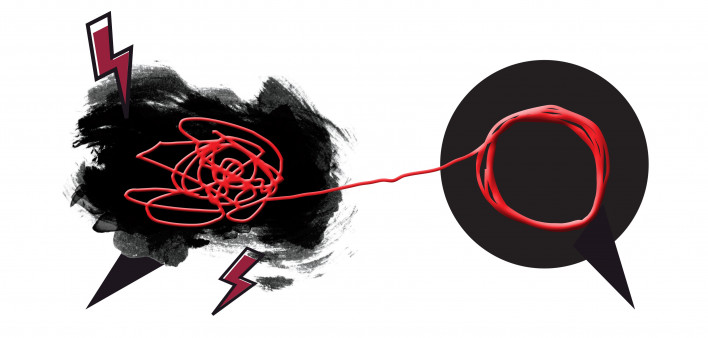
Anger is not an emotion that is universally loved or respected. Many people believe they should avoid getting angry, no matter how justified. They apologize for angry outbursts. Anger is messy, loud, occasionally destructive. Anger disrupts the peace and can be uncomfortable to witness. It is stigmatized, serving as proof to some of people’s inability to control their emotions. And while anger may build over time, it can still be shocking. Anger may be thought of as the “fight” in “fight or flight.” But let’s call it what it really is: grief.
In her groundbreaking 1969 book, On Death and Dying, Elisabeth Kübler-Ross, MD, breaks down the emotional journey of people who are dying into five stages: denial, anger, bargaining, depression and acceptance. Over the years, her findings have been used much more widely to characterize the emotions of people who are grieving. Although the five stages don’t occur in a neat, straight line, I think it’s useful to look at the stage most individuals try to avoid: anger.
How do we get through these horrific times? Think of your anger as a form of protest.
People in the HIV and AIDS community are all too familiar with grief. In the early days, we were overwhelmed by the sheer number of deaths. Compounded, or cumulative, grief occurs when losses pile up, often in a short amount of time. We become overwhelmed because we are unable to process a loss before another one occurs. Grief is not just about lost lives. It entails the loss of possibilities, the loss of hope, the loss of a shared future.
The shock-and-awe tactics of the second Trump administration are designed to knock people off-balance, to sow confusion, to traumatize us. And they have certainly worked, especially at the beginning. We felt numb and were even in denial about what we were witnessing. “Why isn’t someone doing something?” was a familiar plea in the first weeks following Trump’s 2025 inauguration. Many of us waited for someone to take the lead, to show us the way out of this growing nightmare. But no deus ex machina appeared. There was only more destruction, more loss.
Even those of us who read Project 2025, the conservative political initiative spearheaded by The Heritage Foundation, and warned others about it did not anticipate how fast certain government programs and policies would be eliminated. No one can process that much loss from so many different angles at once, which is what this administration was counting on. But eventually, the paralysis and depression we all felt morphed into something else: anger.
Anger was at the root of most, if not all, the great accomplishments by the HIV and AIDS community. “United in anger” is not just a founding principle of ACT UP—it’s what binds us all together. Ignore us? Try to stop us? Expect a very public, creative and effective response.
Anger feeds us, gets us moving, brings us together. It’s a response to injustice. It’s a response to helplessness. But beneath the anger is the undeniable reality of grief. We are experiencing so much cumulative grief that it’s hard to keep track. Below, are just a few of the causes of this grief:
- The destruction of the President’s Emergency Plan for AIDS Relief (PEPFAR) and the United States Agency for International Development (USAID), which The New York Times estimates will kill 1,650,000 people the first year;
- The halting of critical research and clinical trials that have given us the hope of ending the epidemic once and for all;
- The rise of anti-science conspiracy theorists in the highest levels of government, most notably Robert F. Kennedy Jr. at the Department of Health and Human Services;
- The erasing of history and over 40 years of accomplishments that changed the course of the HIV epidemic;
- The inability to depend on established public and private financial support for our community;
- The loss of faith in our fellow human beings, especially those who represent us in Washington, DC.
- There are people reading this whose life work has been destroyed. There are people reading this whose lives are in jeopardy. They’re scared. They’re hurt. Why would they not be angry at what has been done to them?
When I interviewed women for my new book, Unstoppable: Straight Women on the AIDS Frontlines, I was initially surprised at the anger they expressed. They had valid reasons for being angry. Before the 2024 election, many of those reasons centered on a perception that the role of women in the HIV and AIDS community had not evolved, that decades-old issues had not been resolved, that they were second-class citizens. Although I agreed with their reasons, I’d never heard them expressed quite so strongly. That frustration and anger only intensified after January 20. It didn’t take long to realize that their anger was an expression of grief for all that they were losing and fuel for the necessary fight ahead.
Perhaps the way to deal with anger is first to recognize it for what it is. You’re angry over the losses. You’re grieving over the losses. Suppressing grief does not make it go away. It will come out, often when you least expect it.
The cemetery scene at the end of the 1989 film Steel Magnolias is an illustrative example. M’Lynn has just buried her daughter and has spent the entire funeral in control, graciously holding back her grief even as those around her, especially the men, fall apart. Finally, after most people have left, the anger surges. “I’m so mad, I don’t know what to do. I want to know why…. I just want to hit something! I want to hit it hard!”
At first, her friends are horrified by her outburst and eventually get her to laugh. But no one denies her right to rage. And she doesn’t actually hit anyone, though Clairee offers Ouiser as a convenient target.
Why does M’Lynn’s rage finally explode at the graveside? Partly because she’d made it through her daughter’s death, funeral and burial holding herself together so that others didn’t worry about her. But I think it happened when it did because she was with friends who understood. No one told her to continue being strong for everyone else, no one told her to get over it. She was with people who made her feel safe letting her anger out.
So how do we get through these horrific times? How do we face a new, more challenging fight than we’ve fought in decades, maybe ever? How do we find the strength to go on? We, too, want to lash out, after all, without lashing out at one another.
It might be useful to think of your anger as a form of protest. You see what’s happening around you, and it makes you mad. Why mask that? To avoid the social stigma associated with expressing anger?
There are days when I feel it’s all hopeless, that the grief for everything that’s been lost will never dissipate. In many ways, it won’t, because no matter what happens, we’ll have to rebuild. Every time we restore something, we’ll get angry again because we had to do this. We’ll always remember this grief, this anger, this rage—and those who caused the destruction. But one thing always helps me and might help you too: friends.
How do you approach someone who is grieving? Do you try to diminish their grief because someone else has it worse? Would you say, “Let me know if you need anything” and walk away?
Given the HIV community’s experience with grief, I would be surprised if anyone were this callous. I expect you would feel a need to sit with that person, to listen, to allow them to express whatever emotions they feel without fear of judgment. You would do that because you’ve been there too, on both sides.
Will sitting with someone temper their anger? Maybe not, but if you allow them to vent—safely, of course—you will help them find a way to channel it.
The Big Chill and Steel Magnolias came out in the 1980s, at a time when there was no good news about HIV and AIDS. None. And though neither movie is about the epidemic, both of those scenes have popped into my head more than once this year in the context of so much loss. Not just because of how grief is expressed in each one but also because of the friendships that help the characters heal.
When we’re grieving, we need to be with people who understand. In the grief community, there are grief accomplices and companions: people who walk with you as you navigate a world forever changed by loss. In the history of HIV and AIDS, we have had buddy programs. We may not be involved in a formal buddy program now, but that’s what we need these days: a buddy, a companion as we navigate our uncharted new reality. We need each other.
Reach out to your friends. Let your anger and grief fuel you now as it did so long ago. And remember: It’s not “alone in anger”; it’s “united in anger.” That’s how we fight back. That’s how we act up. That’s how we win.




1 Comment
1 Comment