

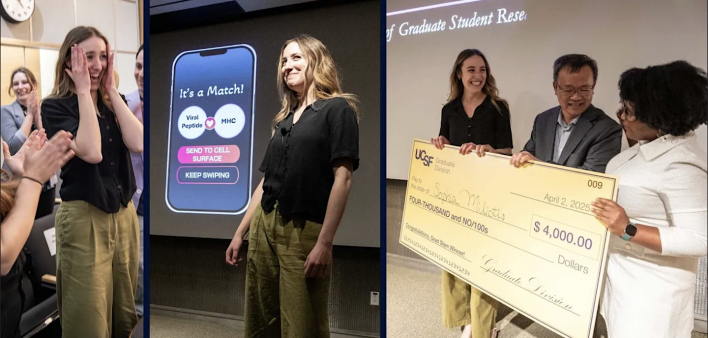
What do the Tinder dating app and our immune system have in common? They are both committed to swiping candidates to screen for the perfect match. However, instead of love, our immune system is looking for signs of viruses in cells that should be destroyed, according to Sophia Miliotis, a University of California San Francisco PhD student and winner of UCSF’s 2025 Grad Slam, the university’s annual PhD student research communication competition.
But, there’s a catch with HIV, the virus that causes AIDS, Miliotis pointed outs. It doesn’t play by the matchmaking rules. HIV evades immune detection by rapidly mutating and generating millions of unique pieces of the virus, called peptides, that our immune system can’t recognize. As a result, some HIV-infected cells escape and lay dormant for decades, possibly coming to the surface if medication is interrupted.
Miliotis’ presentation, “Finding HIV: A Swipe in the Right Direction,” earned her first place from judges as well as the People’s Choice award. [Watch it at the top of this article or on YouTube.] Each of the 10 graduate student finalists delivered a three-minute presentation of their complex work to a combined live and remote streaming audience of more than 600. Finalists were challenged to explain their research in an engaging, lay-friendly manner to a panel of five judges, a few of whom were past competition winners.
As in past years, this year’s Grad Slam, organized by the Graduate Division Dean’s office, was a featured event held in celebration of National Graduate Student Appreciation Week.
Stuck in the infinite scroll
Miliotis, a member of the Pharmaceutical Sciences and Pharmacogenomics (PSPG) Graduate Program, continued her dating analogy, explaining that Major Histocompatibility Complex molecules (MHCs), which are part of the immune system, “swipe” through HIV viral peptides that have evaded the body’s immune system, like singles on a dating app searching for a match.
When they find a compatible HIV peptide, they bond with it, carrying it to the cell’s surface like a beacon to signal where infected HIV cells are located. Then, the body’s immune system recognizes the peptide combo on the cell surface and destroys it.
“Currently, we’ve been simply guessing which HIV peptides might match with the MHC molecule and are testing them one by one. But with millions of possibilities, were stuck in that infinite scroll,” Miliotis explained. “If we could pinpoint the exact peptides that make it to the infected cell surface, we’d have a way to track down these lingering cells and destroy them for good.”
And that’s what she aims to do. Using a high-speed screening tool in her lab, Miliotis introduces thousands of HIV peptides into engineered cells so that each cell carries a single HIV peptide. Not all peptides are a strong match with MHC. However, the stronger the match the more MHC/virus peptide bonded couples show up on the surface of the infected cell to be identified and eliminated.
“If I can isolate the cells with the most MHC molecules and identify which peptide the MHC is matching with, that peptide may be the key to the next HIV therapy,” Miliotis said.
As the top prize winner, Miliotis received a $4,000 check and will go on to compete in the University of California systemwide Grad Slam competition on April 29 in Sacramento, with first-place winners from the other nine UC campuses. Miliotis also received an additional $750 prize as the audience’s People’s Choice winner.
Fighting brain tumors
With a presentation titled “Building Biological Sleeper Agents to Fight Brain Tumors,” Maggie Colton Cove, also of the Pharmaceutical Sciences and Pharmacogenomics program, was the evening’s second-place winner. She took home a $2,000 purse for eloquently summarizing her work on enabling the efficacy of Chimeric Antigen Receptors T cell (CAR-T cell) therapy against brain tumors.
While CAR-T cell therapy is highly effective against blood cancers, Colton Cole explained it is relatively ineffective for brain tumors because the environment in the brain depletes the strength and efficacy of CAR T cells.
Colton Cove, who works in Hideho Okada’s, MD, lab is focused on improving CAR-T cell therapy for brain tumors by using a genetic switch called synNotch to activate the CAR T cells only when they reach the brain, thereby reserving their strength, longevity and tumor-killing ability for when they reach their target.
“These are completely normal T cells until they travel to the brain, hear their code phrase and activate into tumor-killing machines,” Colton Cove said. “(In my lab), these inducible CAR T cells have cleared tumors faster and have kept them away.”
Advanced prenatal care for brain-related disorders
Kaylee Wedderburn-Pugh of the UCSF Biomedical Sciences Graduate Program captured the third place $1,000 prize with “UNDER CONSTRUCTION: Mapping the Blood-Brain Barrier’s Blueprint in Development,” a presentation about uncovering how the blood-brain barrier develops during pregnancy.
Wedderburn-Pugh hopes to advance prenatal and infant care by informing the development of targeted therapies for prenatal and early-onset brain-related disorders.
This news release was published by UCSF on April 4, 2025. It is republished with permission.


Comments
Comments