

A lot has happened at the annual Conference on Retroviruses and Opportunistic Infections (CROI) over the past 32 years. The premier U.S.-based HIV science conference seeks to improve the state of global HIV prevention, treatment and care by bringing together top lab and clinical researchers across their specialties, hosting the release of groundbreaking data and vibrant discussions on research spanning test tubes and labs to medical clinics and outreach vans. And in addition to HIV, CROI now includes sessions on mpox, hepatitis, SARS-CoV-2, long COVID and more.
With a robust scholarship program and a commitment to community involvement at a level rarely seen in scientific gatherings, CROI includes people living with HIV and researchers from around the world, including from those whose nations were already bearing the brunt of U.S. funding cuts.
Even though the nonprofit conference has long discouraged overt protest tactics, it was clear that CROI 2025 in San Francisco, held March 9 to 12, could not remain silent about the cuts to global HIV programs and research already implemented or threatened by the Trump administration.
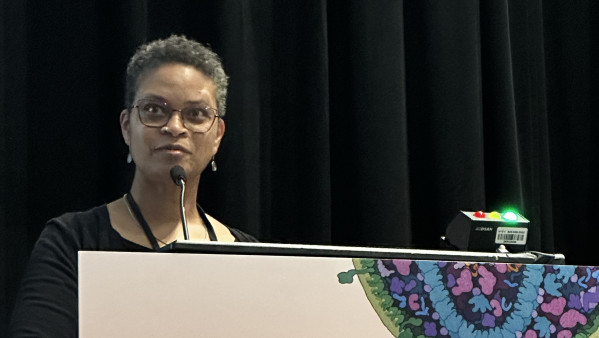
The conference opening session featured a powerfully personal and political talk by Rebecca Denison, a 42-year HIV long-term survivor and founder of Women Organized to Respond to Life Threatening Diseases (WORLD) who urged researchers to move from fear to courage, and to fight against the targeting of transgender people, immigrants and so many others. (Watch Denison’s talk on YouTube.)
The next day’s #SaveOurSciences rally outside the conference center organized by San Francisco AIDS Foundation drew an impassioned crowd of CROI attendees and HIV advocates standing side-by-side.
While an email days before the gathering reminded all attendees that CROI is not government-funded and would not limit their use of overt and accurate language about gender and sexuality, researcher Tonia Poteat, PhD, of Duke University explained the conference could not fully mitigate the impact of new federal policies on the “Meeting the Treatment and Prevention Needs of Transgender Women,” the CROI panel for which she served as moderator, and on the conference at large:
“One of the panelists had to withdraw his abstract because of the Executive Order that essentially bans federal funding for anything related to transgender health. Many federal employees were unable to come due to bans on travel and/or the impact of executive orders banning use of federal funds for certain topic. Unfortunately, many federal employees also lost their jobs, therefore were unable to travel.”
Poteat opened the session noting that an estimated 20% of transgender women worldwide are living with HIV, and that they have a 66-fold higher risk for the virus than the general population. However, they are often sidelined in HIV research itself, which was noted in 2022 in No Data No More: Manifesto to Align HIV Prevention Research with Trans and Gender Diverse Realities (a report for which Davids served as co-author and Minaga as reviewer).
At the session, three young researchers panelists from South America and Europe presented data with important, yet troubling, conclusions. In midwest Brazil, a third of transgender women with a median age of 25 in a 2018-2019 study were living with HIV — but a full half of them had recently acquired it and none had heard of pre-exposure prophylaxis (PrEP). Similarly, another study from central Brazil showed that a third of transgender women—whether urban or rural—were also living with HIV, and few had heard of the HIV prevention option. In France, a large dataset revealed that transgender women were able to access antiretroviral treatment much more quickly as time went on from 1997 to 2022, but access was much slower for those who were immigrants from Latin America.
In an interview the weekend after the conference, Poteat added that “the barriers [to access] start long before engagement with the health system. Ensuring PrEP access will require addressing transphobia, xenophobia, social and economic precarity, and other factors that reduce access to information and resources that would help trans women learn about and benefit from PrEP.”
Given the attacks on trans research, the audience was warmly appreciative of the data. At the conclusion of the presentations, longtime research advocate Brian Minalga, clad in a splendid purple fake fur jacket, stepped up to the mic for the audience Q&A. Speaking as a member of the trans and nonbinary community, rather than in their capacity as deputy director of the Office of HIV/AIDS Network Coordination at Fred Hutchinson Cancer Center, they held a bouquet of purple flowers aloft as they explained:
“I just wanted to thank the [presenters] for the work that you’re doing, particularly at a time when so many are being frightened into compliance with these executive orders to erase my community and our communities. So you’ve come here, and in that context, you presented your work. You’ve shown clearly that your studies are designed with the dedication to the health and well being of trans people, not treating us purely as subjects of academic intrigue, but that really are dedicated to our communities.”
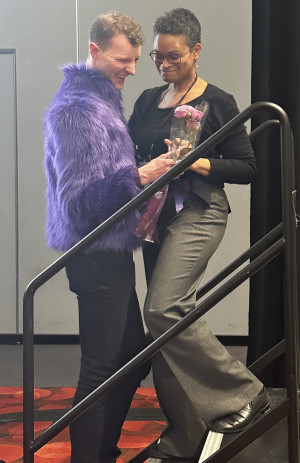
Brian Minalga (left) and Tonia Poteat at CROI 2025JD Davids
Minaga walked to the stage at the front of the room, presenting the flowers with a warm embrace to Poteat, the panel moderator.
In an email interview a few days after the session, Minalga explained:
“[Poteat] is one of the most dedicated researchers I know, and she is always thinking about how to help others like me grow in their careers and contribute to the field… I was on my way to that session, walking down Howard Street after lunch between sessions at CROI in San Francisco, when I passed a beautiful flower shop. I immediately recalled a story I had heard about several years ago, when a group of trans men interrupted proceedings at a conference to present a group of trans women on stage with flowers...I just thought it was such a heartfelt gesture of gratitude that is all too rare. Without another thought, I decided to pick up some flowers to bring to [Poteat’s] session and ask her to accept them as a small token of gratitude from the community… We should all support each other and love on each other more often. Especially in times like the one we’re in.”
Reflecting on the panel, Poteat said “It’s been less than 10 years since CROI had its first plenary talk on HIV among trans women. In this politically fraught time, when the current administration is seeking to erase trans people, it was very important to have a dedicated session to continue to raise the importance of addressing HIV in this group of people.”
But the fear of further cuts and suppression of research and HIV programs remains very much in her mind as a looming threat against trans lives.
“There remains a great deal of discrimination, erasure and criminalization of trans women around the world. This makes it hard to get funding to do this research and sometimes makes it hard to get people to take part in research [because they fear for their safety]. I’m heartbroken at what we will lose in real progress we were beginning to make in understanding and addressing the disproportionate burden of HIV among trans people around the world. The dismantling of USAID, slashing of research funding, and restrictions on speech means that we are likely to see no progress in what we know and likely a rise in HIV vulnerability and worse treatment outcomes as people struggle to access services.”
In a phone conversation the week after the conference, Positive Women’s Network–USA co-director Keiva Lei Cadena concurred on the importance of research on trans lives, explaining that “it’s our most powerful tool. Right now, we’re at a point where unfortunately we have to prove our existence, and it seems that our voices are not strong enough, our voices are not being heard. Data can speak volumes to say we really do exist. We are young people, we are workforce people, we are students, we are mothers and fathers, and here is what shows it, because they don’t want to hear our voices.”
JD Davids is a disabled, trans “illder,” longtime HIV activist, PrEP user and member of the What Would an HIV Doula Do collective. He pens The Cranky Queer Guide to Chronic Illness: Strategies for Health and Wellness in Sick Times and is writing Sick F*cks, a memoir about queer activist history and becoming a Sex God during the COVID-19 pandemic.
Click here for more reports for CROI 2025.


1 Comment
1 Comment