

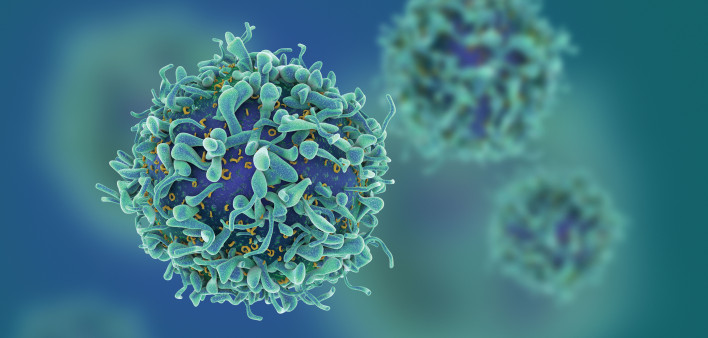
A one-time infusion of CAR-T therapy using engineered T cells that target HIV appears safe and led to delayed viral rebound or sustained viral suppression in a small early study presented at the American Society of Cell and Gene Therapy annual meeting this month in Boston. This approach is in its early stages, however, and years of further research lie ahead.
Of the nine participants who received the reprogrammed T cells, one has maintained an undetectable or very low HIV viral load for nearly two years after stopping antiretroviral therapy, a second has been in remission for almost a year and a third showed transient viral control for about three months. All three started antiretrovirals soon after infection, adding to the evidence that very early treatment improves the prospects for a functional cure.
“Although the primary focus of the study was safety, a few participants experienced better-than-expected outcomes following interruption of antiretroviral therapy,” said principal investigator Steven Deeks, MD, of the University of California San Francisco. “We are particularly interested in two individuals who have maintained control of HIV with undetectable viral loads for extended periods.”
Antiretroviral therapy can keep HIV suppressed indefinitely, but the virus inserts its genetic blueprints into CD4 T cells and establishes a long-lasting viral reservoir that is nearly impossible to eradicate. Cure researchers have tried many different strategies to control the virus, shrink the reservoir and boost immune response, but so far progress has been modest.
Chimeric antigen receptor T-cell therapy—better known as CAR-T—is a type of adoptive cell therapy in which a patient’s T cells are genetically reprogrammed using artificial receptors, creating a “living drug.” Though best known as a treatment for blood cancers like leukemia and lymphoma, CAR-T was initially developed in the 1990s for HIV, and it is now being explored for other indications, including autoimmune diseases.
This first-in-human Phase I/II (NCT04648046) evaluated the safety and preliminary efficacy of a duoCAR technology developed by Caring Cross, a nonprofit focused on novel cell and gene therapies for cancer, HIV, sickle cell disease and other conditions. The study was supported by funding from the California Institute for Regenerative Medicine.
The experimental treatment involves first collecting a sample of T cells using a process called leukapheresis. These cells are modified using a lentivirus vector that encodes receptors that target HIV’s envelope protein and block a receptor the virus uses to enter cells. The modified cells—dubbed LVgp120duoCAR-T—are then multiplied in a lab and reinfused back into the body. Preclinical studies showed that this approach suppressed HIV in laboratory cultures and in mice.
Nine people so far have received the novel therapy, starting with the first participant in 2022. They were on continuous antiretroviral therapy and had an undetectable viral load for at least a year. All had a current CD4 T-cell count of at least 500 and had never fallen below 300.
When used for cancer treatment, patients typically undergo conditioning chemotherapy to make room in the bone marrow for the modified T cells. In this study, one cohort of three participants received no conditioning therapy. In the second and third cohorts, six participants received low-dose cyclophosphamide conditioning three days before a single infusion of a low or high dose of the engineered cells. The same day they received the CAR-T infusion, they stopped their antiretrovirals in a carefully monitored analytical treatment interruption.
All three of the participants who did not receive conditioning chemotherapy showed no evidence of the CAR-T cells in their blood, and they experienced rapid HIV rebound after stopping their antiretrovirals.
Among the six people who received the mild conditioning regimen, two have maintained an undetectable to very low HIV viral load after stopping antiretrovirals, one for nearly a year and the other for nearly two years. A third participant temporarily controlled HIV for nearly three months. All three had started antiretrovirals within weeks after HIV infection, suggesting that very early treatment may limit the size of the viral reservoir and enable durable remission.
In addition, some other participants who did not achieve sustained viral control did show delayed HIV rebound compared with the typical time frame after stopping antiretrovirals, suggesting some degree of immune-mediated HIV suppression even in partial responders, according to a Caring Cross news release.
The experimental treatment was generally well tolerated with no serious adverse events attributed to the CAR-T cells. However, one person did experience decreased white blood cell counts due to the conditioning regimen.
This trial is ongoing and future studies using new versions of the therapy are in the works.
“This work represents the culmination of years of scientific and clinical effort to develop a therapy that harnesses the body’s own immune cells to fight HIV,” said Caring Cross founder and executive director Boro Dropulić, PhD. “While the clinical data are encouraging, the vector used to generate the anti-HIV duoCAR-T cells reflects a first-generation design—an important step toward a definitive therapeutic solution. We have already advanced next-generation versions that we expect will further enhance the potency and durability of the anti-HIV response, bringing us closer to a lasting, potentially one-time treatment.”
While these findings are promising, research on CAR-T therapy for HIV is still in its early stages, and it could be many years—if ever—before this type of treatment is available. What’s more, cell and gene therapies are invasive and expensive, so they may not offer a functional cure that is accessible to the millions of people living with HIV worldwide, largely in resource-limited countries. On the other hand, this is the population that stands to benefit most from a one-and-done cure approach because they have limited or sporadic access to lifelong antiretroviral treatment. Caring Cross and others are now working on ways to produce more affordable CAR-T therapies for cancer, and that work could carry over to HIV.
Click here for more news about HIV cure research.



Comments
Comments