

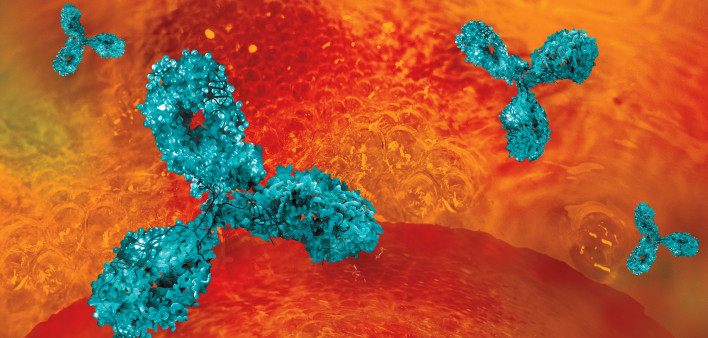
Broadly neutralizing antibodies (bnAbs) appeared to help keep HIV under control after stopping antiretroviral therapy and may play a role in long-term remission, according to studies presented at the Conference on Retroviruses and Opportunistic Infections (CROI 2025).
In the RIO study, three quarters of men who received the bnAbs 3BNC117-LS and 10-1074-LS did not experience viral rebound five months after discontinuing their antiretrovirals, and a third were still in remission at 18 months. In the second study—the first cure trial conducted in Africa—20% of women who received two other bnAbs, VRC07-523-LS and CAP256V2-LS, plus the immune modulator vesatolimod maintained viral suppression without antiretrovirals for 15 months.
People living with HIV normally produce HIV-specific antibodies, but these mostly target parts of the virus that are hidden or highly variable. However, a small proportion of individuals naturally make broadly neutralizing antibodies that target conserved parts of the virus that don’t change much. Manufactured versions of these specialized antibodies are being explored for HIV prevention, treatment and functional cure.
RIO Study
Sara Fidler, MBBS, PhD, of Imperial College London, presented findings from the RIO study, which evaluated the frequency and durability of viral remission in people who received two bnAbs: 3BNC117-LS, which targets the CD4 binding site HIV uses to enter cells, and 10-1074, which binds to the V3 loop on HIV’s surface. (Gilead Sciences is developing long-acting versions of these antibodies, dubbed teropavimab and zinlirvimab, respectively.)
The trial enrolled 68 men in the United Kingdom and Denmark. The median age was approximately 40 years, and 85% were white. They had started antiretroviral therapy (ART) either during primary HIV infection or before their CD4 T-cell count fell below 500, and they had viral suppression for at least a year. People with comborbidities or predicted viral resistance to 10-1074-LS were excluded.
The participants were randomly assigned to receive the bnAb combination or a placebo by IV infusion at baseline, with an optional second dose after week 20. They then began an analytical treatment interruption, restarting ART if their viral load rose above 1,000 copies for six weeks or above 100,000 copies for two weeks, their CD4 count fell below 350 or they experienced clinical symptoms.
At 20 weeks after treatment interruption, 75% of the bnAb recipients maintained viral suppression, compared with just 9% of in the placebo group, Fidler reported. Further follow-up showed that about half of the men in the bnAb group did not experience viral rebound by 48 weeks, and about a third were still in remission at 72 weeks, compared with two men at each time point in the placebo group.
Fidler noted that three patterns of virological response were observed in the bnAb group: 24% experienced rapid viral rebound within 20 weeks, 48% had delayed rebound by 72 weeks—including some with alternating periods of detectable and undetectable HIV—and 24% had sustained viral control for more than 72 weeks. The longest remission has lasted nearly two years so far.
The bnAbs appeared to activate the immune system, and this effect lasted even after circulating antibodies dropped to subtherapeutic levels. What’s more, most participants showed a reduction in their latent viral reservoir (intact HIV DNA in T cells). In a poster presented at the conference, Mohammed Altaf, PhD, of the University of Oxford, and colleagues reported on a biomarker analysis that showed evidence of enhanced T-cell immunity in the bnAb group, suggesting a “vaccinal effect.”
In another poster, John Frater, PhD, of the University of Oxford, and colleagues described one RIO participant who was initially assigned to the placebo group. After stopping ART, his viral load rebounded within four weeks. He then restarted ART and received a single dose of the two bnAbs. Six months later, he tried a second treatment interruption. He soon experienced viral rebound and maintained a low viral load (peak 1,893 copies) for 20 weeks. At that point, he experienced spontaneous viral suppression and has maintained an undetectable viral load (below 20 copies) for about two years. Testing showed that his intact viral reservoir was “extremely small.”
Overall, the bnAb treatment was well tolerated with no serious adverse events related to treatment and no infusion reactions. No one had to restart ART because their CD4 count fell below 350, and there were no cases of HIV transmission, which can occur when viral load becomes detectable. Fortunately, all participants regained viral suppression after restarting antiretrovirals. Some of the men, however, experienced viral rebound to high levels (over 1 million copies) during the treatment interruption and took up to six months to become undetectable again, which has concerning implications for disease progression and transmission.
“You hardly need me to note that we need to look at different types of therapy that are not requiring lifelong treatment,” Fidler said at a CROI media briefing. “Broadly neutralizing antibodies, given as a drip, can maintain viral control for a long time after stopping treatment—longer than has previously been demonstrated—they’re safe, and they seem to be working to reduce the size of the reservoir through an immune-boosting mechanism.”
FRESH Study
Like RIO, most HIV cure research to date has been conducted in the United States or Europe, and a majority of participants have been white men. Thumbi Ndung’u, PhD, of the Africa Health Research Institute in South Africa, presented results from a bnAb study that enrolled African women, who bear a disproportionate burden of the global epidemic.
This Phase IIa trial (NCT05281510), sponsored by Gilead, included 20 cisgender women from the FRESH (Females Rising through Education, Support, and Health) acute HIV infection cohort. These women, who were at high risk for HIV acquisition, were tested twice weekly and started antiretrovirals as soon as the virus was first detected. Most study participants (85%) started treatment during Fiebig Stage I. They had viral suppression on ART for at least 12 months (median seven years) and a CD4 count of 500 or higher.
All participants in this open-label study received oral vesatolimod, Gilead’s toll-like receptor 7 agonist, starting on the first day and administered every two weeks for up to 10 doses. They also received a single dose of two bnAbs, VRC07-523LS and CAP256V2LS, administered via IV infusion on day 7. They were tested at enrollment to ensure that their HIV was sensitive to at least one of the antibodies; 11 were sensitive to both, seven were sensitive to VRC07-523-LS only and two were sensitive to CAP256V2-LS only.
The women stopped antiretrovirals five weeks after the first vesatolimod dose and remained off ART until they had a viral load of 1,000 copies or higher for eight consecutive weeks, ever had a viral load above 100,000 copies or had a CD4 count below 350.
Six women (30%) remained off antiretrovirals without meeting the restart criteria for 48 weeks, including four (20%) who were still in remission at the scheduled end of the study period (55 weeks of treatment interruption). At that point, the four controllers chose to remain off ART with close monitoring. At the time of the report, they were off antiretrovirals for a median of 1.5 years, with one reaching 2.4 years, Ndung’u reported.
The median time to viral rebound (50 copies or more) was 11 weeks. Twelve participants (60%) showed typical viral rebound dynamics, with steadily increasing viral load, while eight (40%) had atypical dynamics—including periodic viral rebound alternating with undetectable viral load—and 20% achieved “durable ART-free viral control.”
Here, too, the antibodies were safe and generally well tolerated with no treatment-related serious adverse events. Eighteen women (90%) experienced mostly mild infusion reactions that resolved within two days. One had mild cytokine release syndrome that led to discontinuation of vesatolimod.
“This first-in-Africa HIV cure trial demonstrates that complex cure studies can be successfully conducted in resource-limited settings with great unmet need via partnership with community and multisector collaborators,” the researchers concluded. “While this regimen did not achieve durable control in all participants, ongoing analyses will inform the development of future cure approaches.”
One limitation of both studies is that they enrolled people who started antiretrovirals very early, while they still had good immune function, underscoring the importance of prompt diagnosis and treatment to offer the best prospects for a functional cure.
Click here for more news about HIV cure research.
Click here for more news from CROI 2025.



Comments
Comments