


By Barb Cardell
Program Director, PWN-USA
I am writing my obituary again.
Thirty-five years ago, people living with HIV were encouraged by our doctors to write last wills and testaments to help “get our affairs in order.” We didn’t have great medications or programs back then. We had a cruel government that made jokes about AIDS. Rather than wait for others to save us, we fed, bathed, and looked after each other. When a friend died, we wrote their obituaries while wondering what we’d say in ours.
At 29, I filled mine with deep rage against the machine that doomed us to die.
Obviously, I didn’t die. And though our current government is attacking the programs and medications that keep our community alive, I don’t plan to die now. My second and penultimate obituary serves as a promise to everyone who died of AIDS and related emotional and physical challenges that I won’t be seeing them soon.
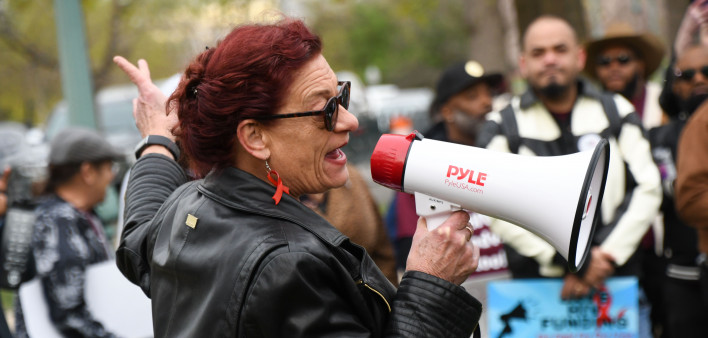
Like my friend Kamaria Laffrey, I am writing against what they want to happen and hopefully showing others how to live. With my fist held in the air, I continue to ACT UP chanting, “Stand up, fight back, fight AIDS.” You can do the same by exhorting our legislators to do their jobs, talking about what is really going on, and inviting our fellow citizens to join these actions.
If you don’t know what to say, read on and see how the friends I’ve lost to HIV/AIDS have inspired me to continue living.
Pre-Obituary for Barb Cardell
Not maudlin — Not a farewell — A warning
Barb Cardell is not dead.
Let’s be clear about that.
This is not to be a soft-focused remembrance. It is not a gentle summation of a life “well lived.” It is not written in pastel tones of closure and gratitude. It is written in sharp ink and bitter anger, with the full knowledge that too many obituaries for people living with HIV were written decades too soon.
Barb came of age in an epidemic that governments met with silence. In the 1980s, while people were dying, institutions debated. While communities organized buddy programs from living rooms and hospital hallways, officials calculated costs. While stigma bloomed, compassion withered.
They learned early that survival was not accidental. It was organized. It was community.
They watched friends bury friends while policies moved slower than funerals. They learned the names of medications and their side effects the way other people memorize song lyrics. They learned the language of public comment, legislative testimony, and budget lines because survival required fluency.
Barb refused to disappear quietly.
Over the decades they insisted that women living with HIV — trans and cisgender women, gender-diverse people, mothers, sisters, Black women, white women, women surviving violence, women surviving poverty — were not footnotes to the epidemic. They were the story.
Community love and strength has been Barb’s North star, organizing not for themselves but for our community.
When government neglect threatened treatment access, community organized.
When funding cuts loomed, community mobilized.
When systems retraumatized survivors, community demanded trauma-informed care.
When policymakers wanted statistics, community brought stories — and then demanded structural change.
This pre-obituary exists for one reason:
To make it absolutely clear that Barb does not plan to go gently into any good night.
There were years when people assumed HIV would be a death sentence.
There were years when people assumed advocates would burn out.
There were years when people assumed women would be grateful for scraps.
They were wrong.
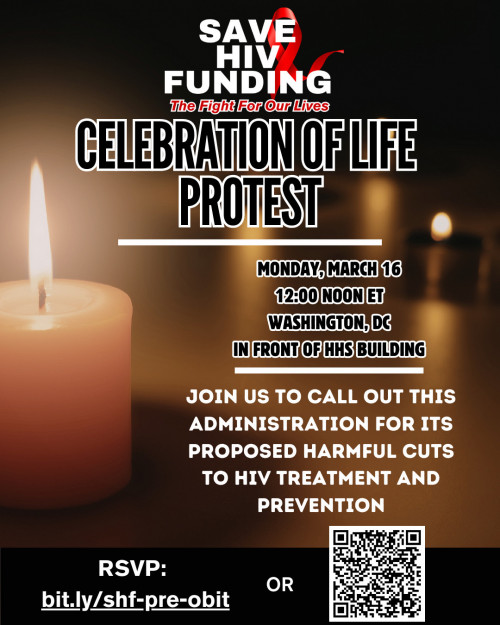
Advocates organized by the Save HIV Funding Campaign will gather outside the U.S. Department of Health and Human Services on Monday, March 16, for a symbolic funeral and celebration of life, drawing attention to mounting concerns over cuts and instability in HIV prevention and care funding:



Comments
Comments