

TL;DR: Mike Barr was a (mostly closeted) gay OSU student in Columbus, Ohio in the early 1980s — when Les Wexner’s Sunday pool parties were an open secret on the gay circuit, and a dashing 28-year-old Jeffrey Epstein was just beginning to insinuate himself into Wexner’s life. This post braids personal memoir with a close reading of Barry Levine’s The Spider — including the explosive Dougan-Recarey tapes thread, the Wexner-Epstein timeline, and the question nobody in mainstream media seems willing to ask: if Wexner’s sexuality was common knowledge in Columbus in 1982, why is it still not common knowledge today?
- The personal: Columbus’s gay scene circa 1982–84; the fraternity that turned out to be “a hotbed of homosexuality”; the friends lost to HIV; the Wexner pool parties in Bexley.
- The investigative: Epstein as a “Ripley figure”; the 700-CD cache of alleged surveillance tapes; Detective Recarey, John Mark Dougan, and Moscow; the Wexner-Epstein timeline (1981–1993+).
- The unanswered question: Why have Epstein’s known enablers and co-conspirators — Adrianna Ross, Sarah Kellen, Nadia Marcinkova, Lesley Groff, Ghislaine Maxwell — been largely left alone?
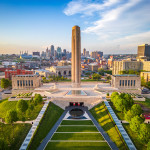
[IMAGE: Columbus, Ohio circa early 1980s — a street scene or campus shot evoking the era]
Reading “The Spider”
I’m only knee-deep in Hulu’s Victoria’s Secret romp but have been absolutely devouring Barry Levine’s "The Spider" these past couple of weeks.
While waiting for my local library branch to ship me a hardcopy, I had laudably worked my way up to chapter 21 — the equal parts stunning and preposterous NPA: “Acosta: The Inside Man.” I say “laudably” because it’s difficult to stick to anything for more than a day or two in these times. I blame the batshit crazy news. Every morning you have to scan twenty news sources just to prepare for the day — then rinse, wash, repeat at sundown.
Fortunately, the audiobook version of “The Year of Magical Thinking” — which I had missed both when first published (she was way too whiny then) and on Broadway ($200, no thank you) — was just the right length for my curiously short attention span. Ms. Redgrave’s reading was exactly the required elixir.
Again I digress.
Columbus, 1982
An image of Rupert Everett as Guy Bennett in the opening of the 1984 film “Another Country” — epochally etched into the consciences of my contemporaries, those not taken from us — jumps into my head. “My dear, you must realize what life was like in those days.”
Columbus, Ohio: 1982, 1983, 1984. The city was rocking with gay life. The Limited was kind of the pride of Columbus — I didn’t pay much attention to it, except that classmates were eyeing jobs there. The big pivot to Victoria’s Secret and the fashion shows, I understand now, was just being hatched.
1980s Columbus was rocking with gay life. And talk of Les — the 47-year-old billionaire bachelor.
When I pledged a fraternity in the spring of ’82, I was still dating women. Pretty much animatronic sex, but it was Ohio, so nobody really noticed. Little did I know I wasn’t the only one performing a role I’d been assigned but that wasn’t really me.
I moved into the four-story, gabled fraternity house in the summer of ’83 — a rather imposing old home taking up nearly an entire block between 13th and 14th streets, just two blocks from High Street. Only the very top of the frat pecking order got his own room, so my sweet, driven “little brother” from Upper Arlington and I decided to bunk together. His living nearby turned out to be a perk: he went home nearly every weekend, and once my social life took off, I had no one to report to when arriving home at dawn.
We were all expected, in that time and environment, to sport sockless penny loafers or Docksiders and erect Lacoste collars. Performative golfwear was also a thing — a course had recently opened across the Scioto River in Dublin. Columbus’s second great pride. (Third was probably Nationwide Insurance.)
And as it turned out, nearly the entire house was homo.
I reluctantly joined a fraternity in an attempt to butch myself up. Just my luck — it turned out to be a hotbed of homosexuality.
The 2 a.m. Parking Lot at Imaginations
Imaginations was really the only gay place to dance, adjoined at the entryway by a quieter bar lounge called Kismet (or was that Tradewinds?). New to me, and as surely goes without saying, both terrifying and exhilarating à la fois.
There were also several other colleges feeding into Columbus’s scene: CCAD, Franklin University, Ohio Wesleyan, Capital University, Ohio Dominican, and about a half hour east, Denison. Fifty miles northeast via US62 — bisecting what was Wexner’s Reagan-era version of Levittown — was even Kenyon College. A fact (along with my total unawareness of Oberlin’s existence) I rue to this day. Just to say: there were a lot of college-age homos to be had for a town the size of Columbus.
Most of the final hooking-up took place in the parking lot after the 2 a.m. last call. That’s also where you’d learn of the private house parties.
It was not so much the dance floor as the parking lot — as the place closed at 2 a.m. — that turned out to be the Great Equalizer: the all-guys-from-all-places egalitarian al fresco mixer, where seconds-long eye contact could finally be followed by introductions, invitations to private parties, and where I first learned of Columbus’s annual Red Party. And of Les Wexner’s swimming pool in Bexley.
It was kind of an open invitation. All the 18–24-year-old gay boys in Columbus would flock over to Bexley on Sundays to lather on the Bain de Soleil and cannonball into Les’s pool. I was still way too shy for any of this. I cannot speak of it firsthand.
The Friends We Lost
My heartthrob from that time, Ted, was one of the first to fall when HIV ambushed us all. Michael W., Ted’s pre-med mate, was in jail last I heard. Todd died after a stroke in Florida a few years ago. Alec of brain cancer, in Mexico. I’ve lost track of David W. and the two Mikes. My fellow frat brothers — Chris and Doug and “Bon Bon” and Drew and, oh gosh, that little fellow in Campus Crusade who was praying so hard not to be gay. (Pretty sure the praying thing didn’t work.) My “big brother” Mark too was determined to pray away the gay — when he wasn’t busy staffing the lower-level men’s room in Arps Hall. It’s so sad, and so wrong, that we were taught to feel shame for simply not wanting women.
The Question Nobody Asks
All of this is a way of saying: if it was common knowledge in 1982 or 1983 that Mr. Wexner liked boys — well, men — why is it not common knowledge today?
If it was common knowledge in 1983, why is it not common knowledge today?
Sure, he could do the whole Barry Diller thing and write a book about it at 90. But this was also right about the time that a 28- or 29-year-old Jeffrey — exuding confidence, working that Jersey swagger — insinuates himself into his life.
Have you seen that Cosmo “Bachelor of the Month” photo of him from July 1980, when he was still at Bear Stearns? No wonder Ace Greenberg’s secretary shagged him.
The timeline is a little fuzzy, and I’m working to tighten it up. But it seems to be within a matter of months from Jeff’s first Columbus visit that Leslie is:
- Dyeing out the grey for the first time
- Donning jeans so tight you could see his junk
- Hiring a live-in personal trainer
Almost certainly: a first in-person orgasm.
Reminding me of Mia’s birthday present to the lifelong sexually repressed Valentina in White Lotus, Season 2 — desires she had always been too afraid to act on.
Required disclaimer: When asked about this by various journalists over the years, Mr. Wexner has denied any sexual element to his relationship with Mr. Epstein.
Epstein is given — or buys — a 10,000-square-foot house on the Wexner compound, where he apparently moved in and lived for six months. Then the stuff now daily in the news:
- The power of attorney transfer (1992 or 1999)
- The Manhattan townhouse transfer (1989, 1998?, 2011)
The ACT UP Buddy
I phoned up an old ACT UP buddy yesterday — someone Wexner regularly flew to Columbus during the 1990s. He too fit the Epstein profile: disarming charisma, killer good looks, a sexy voice, and that inimitable Jersey swagger.
“Epstein was a total Ripley figure,” he finally offered, after some insistence. “More chameleon than spider. He would be whoever he needed to be in order to get what he wanted.”
He kind of dismissed the sex “scandal” piece as a distraction — Epstein’s “side kink” — and zeroed in instead on the alleged $47 million that Jeff had allegedly “stolen” from Les.
“The general rule in these worlds is that they expect you to be skimming 10%, maybe 15%, off the top — and won’t say anything. Any more than that, and you might get called on it.” His point being: if Jeff took $47M and Les essentially did nothing about it, how much was he being paid? Extrapolate from the “10% skimming expected” rule and you’re potentially looking at $470 million.
A few days after we spoke, he messaged me: “I see now that at least one girl was 11 and one 14. Eck!” — with a link explaining statutory rape in New York State: no one under 17 can legally consent to sex. No Romeo and Juliet exemption; no “unaware of age” defense.
Wolf notes that if Epstein left $600M upon his death, there is “more than likely another $600M we don’t know about.” And Mea Culpa made the point that it probably cost a minimum of $50M annually just to maintain the Manhattan, Paris, Palm Beach, New Mexico, and St. James Island properties.
But it all seems to start with Les. Yes, I know about Tower Financial (Hoffenberg put away for 18 years; Epstein: nothing) and the stint in the arms trade. But the story still seems to begin with Les. I wish more people would focus on that time — and on that transformative friendship.
[IMAGE: New Albany, Ohio — Wexner’s estate or compound, conveying scale and insularity]
The Dougan Tapes: A Thread From “The Spider”
My local library branch is clamoring for the book back. When I initially reserved it, I was the only one on the list. Now the wait-list is apparently hundreds long. So here are a quick batch of last-minute notes before I have to relinquish it.
In Levine’s final chapter, “Out of the Woodwork,” two Palm Beach figures emerge: John Mark Dougan of the Palm Beach County Sheriff’s Office, and Detective Joseph Recarey, reported to have been the lead detective on the 2005 Epstein/Palm Beach investigation.
Around 2010, Recarey phones Dougan and invites himself over to talk. He shows up with a batch of file boxes: roughly 700 CDs, each labeled with the date and room in which the video was taken. The videos are believed to have been recorded between 1995 and 2005 at Epstein’s Palm Beach mansion — not at his island — and are said to show sex acts between men and underage girls. Recarey, worried that the state attorney’s office or the sheriff’s office might try to destroy this evidence, asks Dougan to upload everything to a hard drive for safekeeping. Dougan does — 1.5 terabytes of video and scanned documents.
In March 2016, the FBI raids Dougan’s home. His phone and computers are seized; the Palm Beach County state attorney obtains a separate search warrant. Dougan reappears in — are you ready? — Moscow, seeking political asylum, and starts a new life as a cybersecurity consultant.
Epstein is arrested at Teterboro in July 2019. Dougan begins posting on Facebook claiming that before the FBI seized the materials in 2016, he had made a backup cache and taken it with him to Russia. In September 2019 — a month after Epstein is found dead — the Times of London runs a story that MI6 has taken interest in Dougan’s alleged stash — because Prince Andrew was said to appear in the videos.
“True crime” author Ron Chepesiuk visits Dougan in Moscow. Dougan plays brief snippets of about seven videos — apparently to establish that they’re real. Other than seeing an older man and a young girl, Chepesiuk reports that no one was identifiable. Detective Recarey, meanwhile, died on Cinco de Mayo, 2018 — at age 50.
Note: This was written in late July 2025. The following day, author Andrew Lownie was telling Times Radio that Putin now had in his armory this alleged “Prince Andrew-Jeffrey Epstein” video — which he might subtly brandish in one-on-one talks with Trump. God save Ukraine.
Levine goes further: "The fact that this material arrived in Russia in 2016, just as Donald Trump was in the thick of a presidential campaign, raises a litany of questions. Could Dougan’s alleged material be connected to the kompromat that Putin is often rumored to have on the man — Jeffrey Epstein’s best friend — who would become president of the United States?"
The Enablers Who Disappeared
One last thing that bugs me: why have these enablers and co-conspirators been granted what amounts to a strange witness protection program — unbothered by media or law enforcement?
- Adrianna Ross, former Polish model
- Sarah Kellen (now Kensington) — said to have dyed her hair brown and moved to Hawaii
- Nadia Marcinkova (now Marcinko), former Slovakian model, founder of Aviloop
- Lesley Groff, Epstein’s executive assistant, now said to be 58
- Ghislaine Maxwell, who apparently married “tech millionaire” Scott Borgerson in 2016. Maxwell is reported to believe that both her father and Epstein were murdered.
THANK YOU FOR YOUR ATTENTION TO THIS MATTER.
The Wexner-Epstein Timeline
Sourced primarily from Vanity Fair (Gabriel Sherman):
- 1981: Epstein fired from Bear Stearns
- 1983–86: Epstein, in his early 30s, is described as truly dashing — “from the right angle might be mistaken for Richard Gere”
- 1985: New York Magazine cover — “The Bachelor Billionaire” — Wexner poses with two women and has to explicitly state that he “enjoys the company of women” (full text)
- 1986: Epstein asks Robert Meister to introduce them; meeting takes place at Wexner’s Aspen home
- 1986–89: Wexner and Epstein become “virtually inseparable”
- 1987: Robert Morosky and Wexner part ways
- 1988: Wexner drops longtime friend Jim Duberstein — apparently over Epstein
- 1989: Boston Globe profile of Wexner; his September diary entry: “I finally like myself”
- 1989: Epstein “begins taking an interest in Wexner’s romantic life”
- 1990: Wendy Meister introduces Wexner to Abigail Koppel
- November 1991: Robert Maxwell’s mysterious death at 68
- 1991: Epstein’s name begins “appearing all over” New Albany planning documents
- 1991: Wexner co-founds, with Seagram’s Charles Bronfman, the Mega Group
- 1992: Epstein buys the 23-room New Albany guesthouse — originally built for John W. Kessler and his wife — for $3.5M
- 1993: Epstein arranges the prenup and attends the Wexner-Koppel January wedding
- 1993+: Epstein begins flying to Columbus accompanied by Ghislaine Maxwell
Mike Barr, a longtime POZ Contributing Editor and founding member of the Treatment Action Group (TAG), is a functional medicine practitioner and herbalist in NYC. Reach out to him here. Or sign up for his curated professional-grade supplement dispensary — 30% off your first order, 25% off all auto-refills — here.